Stop Overpaying: 7 ARV Pitfalls for Investors, Checklist Inside
The single most damaging ARV mistake is anchoring your number to the best available comp or the renovation you dream of doing, instead of a conservative, documented range built from recent sold comps. Fix it by using a defensible adjusted sales comparison method, realistic rehab and holding costs, and a stress-tested number that survives an appraiser’s scrutiny before you underwrite a deal against it.
TL;DR:
- Rely on recent sold comps within a 3 to 6 month window and within a tight radius to ensure the ARV reflects current market conditions.
- Avoid outlier comps and cherry-picking the highest sale to prevent inflating the ARV beyond what appraisers will accept.
- Incorporate at least 10% to 20% contingency into rehab budgets and match renovation levels to neighborhood standards to preserve margin.
- Conduct stress tests by recalculating ARV at 5% and 10% below the initial estimate to assess deal viability under appraisal shortfalls.
- Use structured tools that filter comps and tie rehab costs directly into ARV modeling to enhance consistency, discipline, and defensibility.
Table of Contents
- The Top ARV Pitfalls to Avoid on Every Deal
- How to Pick Defensible Comps and Build a Conservative ARV Range
- Estimating Rehab Costs Without Torching Your Margin
- Appraisal, Financing, and Market-Risk Traps
- Underwriting Checklist and Red Flags Before You Make an Offer
- How Data and Calculators Reduce ARV Errors
- Why I Trust the Conservative Number Every Time
- Get a Conservative ARV in Minutes, Not Hours
- Sources
The Top ARV Pitfalls to Avoid on Every Deal
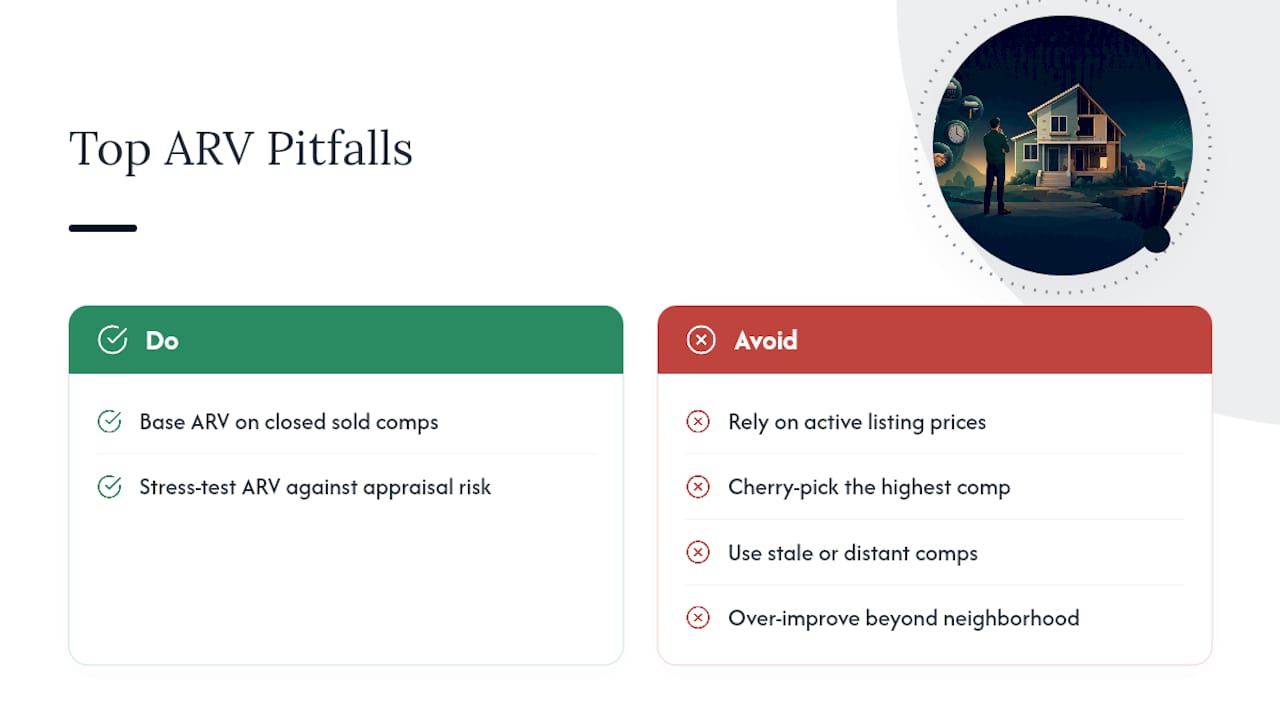
Every one of the mistakes below shows up repeatedly in flip and BRRRR deals that go sideways. Learning to spot them before you make an offer is what separates a repeatable business from a one-time lucky flip.
1. Using active listings instead of closed sold comps. Listing prices are aspirational. A seller’s asking price tells you nothing about what a buyer actually paid, and using it inflates your ARV before you’ve even started. Guidance from Freedom Mortgage is blunt about this: base your ARV on sold data, not on what’s currently sitting on the market.
2. Cherry-picking the highest comp in the set. If you have five comps and lean on the one that sold $40,000 above the rest, you’ve built your ARV on an outlier, not a market. This anchoring effect is one of the most common ways investors talk themselves into a number that never gets appraised.
3. Using stale or geographically mismatched comps. A sale from 14 months ago in a market that’s since cooled, or a comp two miles away across a school district line, tells you almost nothing useful. Talimar Financial recommends staying inside 3 to 6 months and a tight radius before you widen your search.
4. Over-improving for the neighborhood. A pool or a designer kitchen might look great, but if the surrounding homes cap out at a certain price, your costly upgrade won’t move that ceiling. OffMarket Deck points to exactly this pattern: renovation spend that outpaces what buyers in that specific market will actually pay for.
5. Underestimating rehab and soft costs. Hard costs are only part of the picture. Permits, insurance, utilities, and holding costs during the renovation period quietly erode margin when they’re left out of the budget.
6. Leaning entirely on automated valuation tools. An AVM is a screening tool, not a final answer. It can’t see condition, layout quirks, or the half-finished addition in the backyard, so treat it as a starting point, never a conclusion.
7. Ignoring appraisal risk. An aggressive ARV that looks great on your spreadsheet can fall apart the moment a lender’s appraiser comes in $20,000 lower, which directly threatens refinance proceeds on a BRRRR deal.
Pro Tip: Before you finalize an ARV, ask yourself which pitfall above you’re most likely to fall into on this specific deal, then double check that one item first. Most bad ARVs fail for one dominant reason, not seven.
How to Pick Defensible Comps and Build a Conservative ARV Range
A defensible ARV starts with a disciplined comp pull, not a gut feeling. Filter your comp set before you touch a single adjustment number.
- Pull sold comps from the last 3 to 6 months, starting with the tightest radius available and expanding only if you can’t find enough matches.
- Match beds and baths as closely as possible, and prioritize comps that share a similar renovation condition to your planned finished product.
- Adjust for square footage, garage or parking, lot size, and finish quality using consistent dollar or percentage rules you apply the same way across every comp.
- Treat any comp that’s dramatically higher or lower than the rest as an outlier and either explain the gap in writing or exclude it.
- Widen your radius only in deliberate steps, and document why you crossed further out each time.
Once your comps are adjusted, you’ll have a spread, not a single figure. That spread is the point: it shows you the realistic range of outcomes, and your job is to pick a number toward the conservative end rather than the top. Ridge Street Capital’s guide walks through the adjusted sales comparison method appraisers themselves use, which is exactly the method you want backing your number if a lender ever questions it.
Pro Tip: Keep a simple log of every adjustment you made and why. If an appraisal comes back low, that documentation is what supports a reconsideration of value request instead of just accepting the lender’s number.
Estimating Rehab Costs Without Torching Your Margin
Rehab budgets fail in three places: hard costs (materials and labor), soft costs (permits, design, inspections), and holding costs (utilities, insurance, loan interest while the property sits). Missing any one of the three understates your true spend.
- Build in a contingency of 10% to 20% of your hard cost estimate, higher on older homes or anything with unknown systems behind the walls.
- Skip upgrades that exceed what your comps support. A pool rarely returns its cost in most markets, according to OffMarket Deck’s breakdown of common over-improvement mistakes.
- Match your finish level to the comps you’re using to justify your ARV. If your comps are mid-grade renovations, a luxury finish won’t lift your value to match your spend.
- Get at least two contractor bids on major scope items, and compare line by line, not just the bottom-line total.
- Recalculate your ARV whenever the scope changes. A bigger renovation should raise your comp expectations too, not just your budget.
A rehab cost calculator that ties directly into your ARV modeling catches the disconnect between what you’re spending and what the market will actually pay for it.
Appraisal, Financing, and Market-Risk Traps
Appraisers lean on the adjusted sales comparison method, and they tend to be conservative by nature. That gap between what an investor calculates and what a lender’s appraiser signs off on is where BRRRR deals lose cash. A low appraisal on refinance directly reduces your loan proceeds, per ProInvestorHub’s guide to ARV and financing.
- Run a simple stress test: recalculate your deal at ARV minus 5% and again at ARV minus 10% to see whether the numbers still work.
- If an appraisal comes in low, ask about a reconsideration of value using your documented comp adjustments before accepting the number.
- Keep contingency capital set aside specifically for refinance shortfalls, not just rehab overruns.
- Set a walk away trigger in advance, a specific ARV floor below which you cancel the deal rather than force it through.
Underwriting Checklist and Red Flags Before You Make an Offer
Run this before every offer:
- Pull at least 3 to 5 sold comps within your recency and radius filters.
- Document every adjustment you made and why.
- Get a written contractor bid summary, not a verbal estimate.
- Build in your contingency percentage before finalizing rehab cost.
- Check days on market and current inventory for signs the market is shifting.
- Confirm permits and inspections are accounted for, especially on older properties.
- Note your appraisal risk and recalculate MAO at ARV minus 5%.
| Red Flag | What It Signals |
|---|---|
| Single outlier comp driving your number | Anchoring bias, not a real market price |
| Comps across a highway or school district | Comparing two different micro-markets |
| Comps older than 6 months | Value may not reflect current conditions |
| Wildly variable contractor bids | Scope isn’t clearly defined yet |
| Missing permit history | Hidden rework or code issues ahead |
How Data and Calculators Reduce ARV Errors
A structured tool can’t eliminate judgment from ARV work, but it can stop you from skipping steps under deadline pressure. Real Estate Investor Toolkit’s calculators are built around the same discipline covered above: sold comps first, documented adjustments, and rehab numbers that feed directly into your ARV range instead of living in a separate spreadsheet.
- The ARV calculator pulls comps and lets you test conservative versus optimistic scenarios side by side.
- The comps analyzer helps you filter by recency and proximity so you’re not manually screening out stale or mismatched sales.
- The BRRRR calculator models refinance scenarios so an appraisal shortfall shows up before you’re mid-deal, not after.
Why I Trust the Conservative Number Every Time
ARV work rewards discipline, not optimism. Every deal I’ve broken down that went sideways had the same root cause: someone treated ARV as a target instead of a ceiling. The comp was real, the renovation was well done, but the number itself was never conservative enough to survive contact with an actual appraiser.
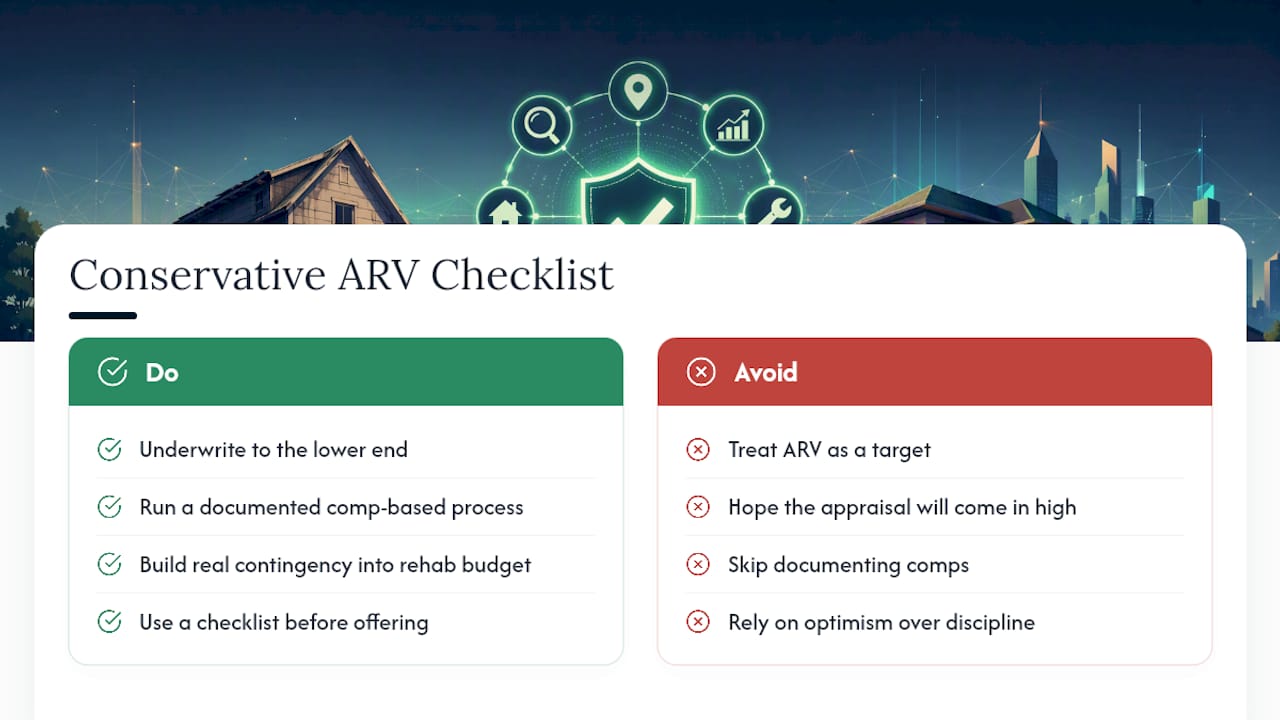
Treat your ARV as the top of a supported range, then underwrite to the lower end of it. That single habit protects more margin than any single negotiating tactic you’ll ever learn. When the comps are tight and the rehab budget has a real contingency built in, you don’t need to hope the appraisal comes in high. You just need it to hold.
Run your numbers through a documented, comp-based process every time, and use a checklist before you ever submit an offer. The deals that work are rarely the ones with the biggest upside. They’re the ones with the fewest surprises.
— Michael
Get a Conservative ARV in Minutes, Not Hours
Real Estate Investor Toolkit gives you a faster path to the same discipline this article just walked through, without building a comp spreadsheet from scratch every time. Instead of manually pulling sold comps, adjusting them by hand, and cross checking your rehab budget in a separate file, you get one workflow that ties comps, adjustments, and rehab numbers into a single conservative ARV.
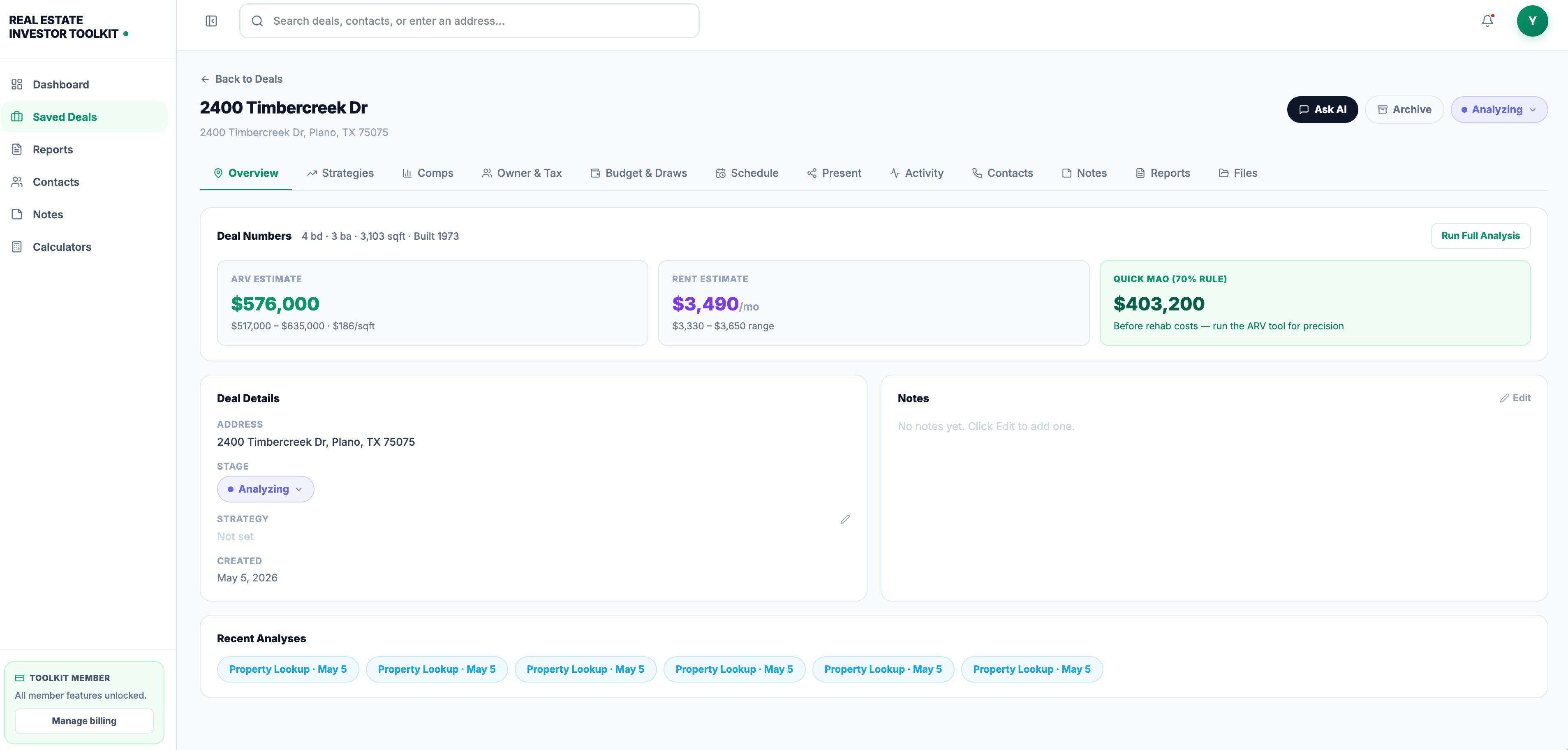
The ARV calculator is built specifically for the pitfalls covered above: it filters comps by recency, lets you stress-test your number at 5% and 10% below your baseline, and pairs directly with the rehab cost calculator so your renovation budget and your ARV stay connected instead of drifting apart. No sign-up is required to run a first analysis, so you can check your next deal’s ARV against a documented, comp-based range before you write an offer.
Sources
- What Is ARV? | Guide for Homeowners and Real Estate Investors
- Top 10 Mistakes Investors Make When Estimating ARV (After Repair Value)
- What Is ARV in Real Estate? Formula, Example, and Mistakes to Avoid | OffMarket Deck
- How to Calculate ARV (After Repair Value): Investor Guide