ARV Loan Meaning: What It Is and How Lenders Use It

An ARV loan is the everyday name for fix-and-flip or rehab financing that is sized, in part, on a property’s after-repair value: the estimated market value once the planned renovation is finished. It is not one standardized mortgage product. Lenders use the completed value as a ceiling, then compare it with other limits, and the lowest limit sets your loan amount.
This guide explains what the term means, how the math works, what these loans cost, and how to test your own numbers before you ask a lender for terms.
TL;DR
- An ARV loan is informal shorthand for rehab financing that considers a property’s projected after-repair value, not a single official loan type.
- Lenders usually cap the loan at a percentage of ARV, then also check cost-based limits. The lower result wins.
- It does not cover 100% of ARV. Published caps in the research run from 60% to 75% of ARV, depending on the lender and your experience.
- Expect interest, points, inspection and draw fees, and a short term. Build them into your offer.
- Run your ARV and maximum offer before you talk to a lender, so your numbers match what the appraiser will find.
Table of Contents
- What does ARV loan mean?
- How lenders use ARV to size your loan
- Does an ARV loan cover the full after-repair value?
- How lenders estimate ARV
- Conventional renovation loans versus hard money
- What an ARV loan costs and what lenders ask for
- Mistakes that inflate ARV and sink loans
- From ARV to your maximum offer
- Our perspective
- Run your numbers before you apply
- FAQ
- Sources
What does ARV loan mean?
ARV stands for after-repair value. It is the estimated market value of a property in its fully renovated condition. CoreVest’s guide notes that ARV is an estimate. It is not your purchase price plus repairs, not the price you hope to get, and not a guaranteed sale price.
An easy way to picture it: you buy ingredients (the distressed house), cook (renovate), and sell the meal (the finished home). ARV is what the meal should sell for, based on what similar meals recently sold for nearby. If you need a refresher on the basics, our guide on what ARV is walks through the definition.
An “ARV loan” then means a loan where that completed value is part of the sizing. You will also hear these called:
- Fix-and-flip loans
- Hard money or private money rehab loans
- Bridge loans for renovation projects
- Renovation mortgages, for the conventional version
Approval rarely rests on ARV alone. Lenders also weigh the purchase price, the current value, your credit and experience, your liquidity, the renovation scope, and your exit plan, according to CoreVest’s overview.
How lenders use ARV to size your loan
The loan amount is the lowest of several limits. Two matter most:
- A cost-based limit. Often a percentage of purchase price plus rehab budget, called loan-to-cost (LTC).
- An ARV-based limit. A percentage of the completed value, called loan-to-ARV (LTARV).
New Silver’s help center shows the logic with real numbers. With a $200,000 purchase cost, a $50,000 rehab budget, 90% LTC and a $290,000 ARV capped at 75%, the limits are $225,000 and $217,500. The maximum loan is the lower figure, $217,500.
A worked example
Here is a simple hypothetical deal, not a quote from any lender:
| Item | Amount |
|---|---|
| Purchase price | $170,000 |
| Rehab budget | $40,000 |
| Total project cost | $210,000 |
| ARV (from comps) | $300,000 |
| 90% of cost | $189,000 |
| 75% of ARV | $225,000 |
| Maximum loan (lower limit) | $189,000 |
In this case cost is the binding limit. If the purchase price were lower relative to ARV, the loan would be limited by the cost side. If the ARV were weaker than you expected, the ARV cap would take over and your required cash would grow.
When the ARV cap blocks a deal
RCN Capital’s example shows how a project can fail the cap. With a $200,000 as-is value, a $300,000 ARV, $75,000 of improvements and 80% acquisition financing, total financing reaches $235,000. That exceeds a 75% ARV ceiling of $225,000, so the borrower must bring more cash or renegotiate.
Does an ARV loan cover the full after-repair value?
No. ARV is a ceiling on borrowing, never the amount you receive. In New Silver’s example the 75% cap puts the maximum below the full ARV. Fannie Mae’s HomeStyle Renovation framework works the same way in principle: for a purchase, LTV is based on the lesser of purchase price plus renovation costs or the as-completed appraised value.
What are typical caps? They vary by lender and borrower:
- Builder Finance’s January 2026 fix-and-flip matrix shows ARV caps ranging from 60% to 75% depending on borrower experience.
- Nav’s 2026 guide says hard-money lenders commonly cap financing at 65% to 75% of ARV, with 70% described as the most common ceiling.
- Lima One describes a program that offered up to 75% loan-to-ARV. That is a lender-specific example, not a universal rule.
Treat any percentage as a starting point and get the current number from the lender you plan to use.
How lenders estimate ARV
Your estimate is not the number that counts. The lender’s is.
For conventional renovation loans, the lender orders an as-completed appraisal to set the maximum mortgage, check LTV and calculate the loan amount, as described on Fannie Mae’s HomeStyle Renovation page.
Private lenders do something similar. One lender explains that it orders an independent appraisal reporting both the as-is value and the subject-to-completion ARV, with ARV based on comparable sales of similar finished properties nearby. Because the appraiser combines the as-is condition, your scope of work and finished comps, a rosy investor estimate gets corrected.
Good comps share these traits, according to LendingStreet’s guidance: recent, nearby, similar renovated sales matched for size, bedrooms, baths, lot and finish level.
If you want to build your own estimate first, use our ARV calculator. For a faster remote process, see our walkthrough on remote ARV analysis.
Conventional renovation loans versus hard money
There are two broad routes to renovation financing based on completed value.
Conventional renovation mortgages. Fannie Mae’s HomeStyle Renovation is the best-known example. Its product matrix lists eligible properties as one- to four-unit principal residences, one-unit second homes and one-unit investment properties, with renovations to be completed within 15 months of closing. Its purchase loans can reach up to 75% of the lesser of purchase price plus renovation costs or the as-completed appraised value, while the matrix separately states a maximum LTV of up to 97% subject to eligibility rules, per the product page.
A few rules matter if you plan to do work yourself. DIY work on eligible one-unit properties may not exceed 10% of as-completed value, needs advance lender approval, and completed items costing more than $5,000 require inspection, per Fannie Mae’s selling guide. If your project is mostly exterior work, such as a new roof, it helps to understand roofing and siding financing alongside the larger renovation loan.
Hard money and private lenders. These are built for investors who need speed and short terms. They lean heavily on ARV, scope of work and your exit. For a full side-by-side, read our guide on hard money versus conventional financing for a flip.

What an ARV loan costs and what lenders ask for
Before you rely on a loan, put the full cost stack into your deal math.
Typical costs
Published figures vary, so confirm with your lender:
- Builder Finance’s matrix: an 8.5% rate, 1% points, an initial eight- to 12-month term plus a four-month extension, a $950 underwriting fee and a $150 draw fee for that program (source).
- Nav’s guide: hard-money and bridge loans commonly carry rates of 9% to 12% and terms of roughly six to 18 months, with points of 1% to 4% and inspection fees of $150 or more per visit (source).
Cape Henry Capital gives a useful illustration. A $300,000 loan at 11% held for six months produces $16,500 of interest. A 2% origination fee adds $6,000, for roughly $24,400 in financing costs before other expenses. Longer holds cost more, which is why timelines matter.
Typical documents
A hard-money file commonly includes a purchase contract, an itemized rehab budget with contingency, property photos, comparable sales supporting ARV, and bank statements showing closing liquidity. Completed flip history is optional, according to Pimlico Capital’s requirements page.
Draws and exits
Rehab funds are usually released in stages as work is inspected. Our articles on a hard money draw schedule and a rehab draw schedule explain how to plan cash flow between draws.
Lenders also want a clear repayment plan. Willowbrook Capital lists sale, refinance into long-term debt, and a documented sale of another asset as possible exits, and says 12 months is common and 18 months the upper end for many bridge deals.
Mistakes that inflate ARV and sink loans
An overestimated ARV hurts twice. It leads you to overpay, and it leads to a gap when the appraiser comes in lower. Common errors:
- Using list prices. Active and pending listings are not sold prices. Practitioners warn against using active listings instead of sold comparables.
- Stale or distant comps. A sale from last year across town tells you little.
- Cherry-picking one high sale. Use a set of comps, not the best one.
- Over-improving. Spending past what the neighborhood’s price ceiling supports adds cost, not value.
- Counting unpermitted square footage. An appraiser may not.
- Ignoring holding costs. Permits, delays, interest, insurance, taxes and utilities add up.
LendEDU names three central risks: overoptimistic ARV can cause overborrowing, renovation costs can exceed estimates, and a market decline can reduce the sale value. A practical habit from one private lender’s guide is to stress-test ARV 5% to 10% lower and ask lenders early how they determine it.
To keep the rehab side honest, see our guide on estimating rehab costs and use the rehab cost calculator.
From ARV to your maximum offer
The lender caps what it will lend. You still decide what you will pay. Many flippers use the 70% rule: maximum purchase price equals ARV times 0.70, minus repair costs. It leaves a 30% margin for loan costs, holding costs, closing costs and profit.
Using the earlier example: $300,000 x 0.70 = $210,000, minus $40,000 of repairs, gives a maximum purchase price of $170,000. If the seller wants more, the deal needs a better ARV, lower repairs or a pass.

That figure is your maximum allowable offer. Our guides on what MAO means and ARV versus MAO show where each number fits. Wholesalers can also see the wholesale offer formula. If you plan to refinance and hold the property, run the BRRRR calculator, because the refinance is also tied to value.
Our perspective
Most deals that go wrong did not fail at the loan. They failed at the first number: the ARV.
We built our calculators around that idea. If your ARV rests on verified sold comps and your rehab estimate is honest, the lender’s appraisal tends to confirm your math instead of surprising you. That is the point of running the numbers before you ever apply.
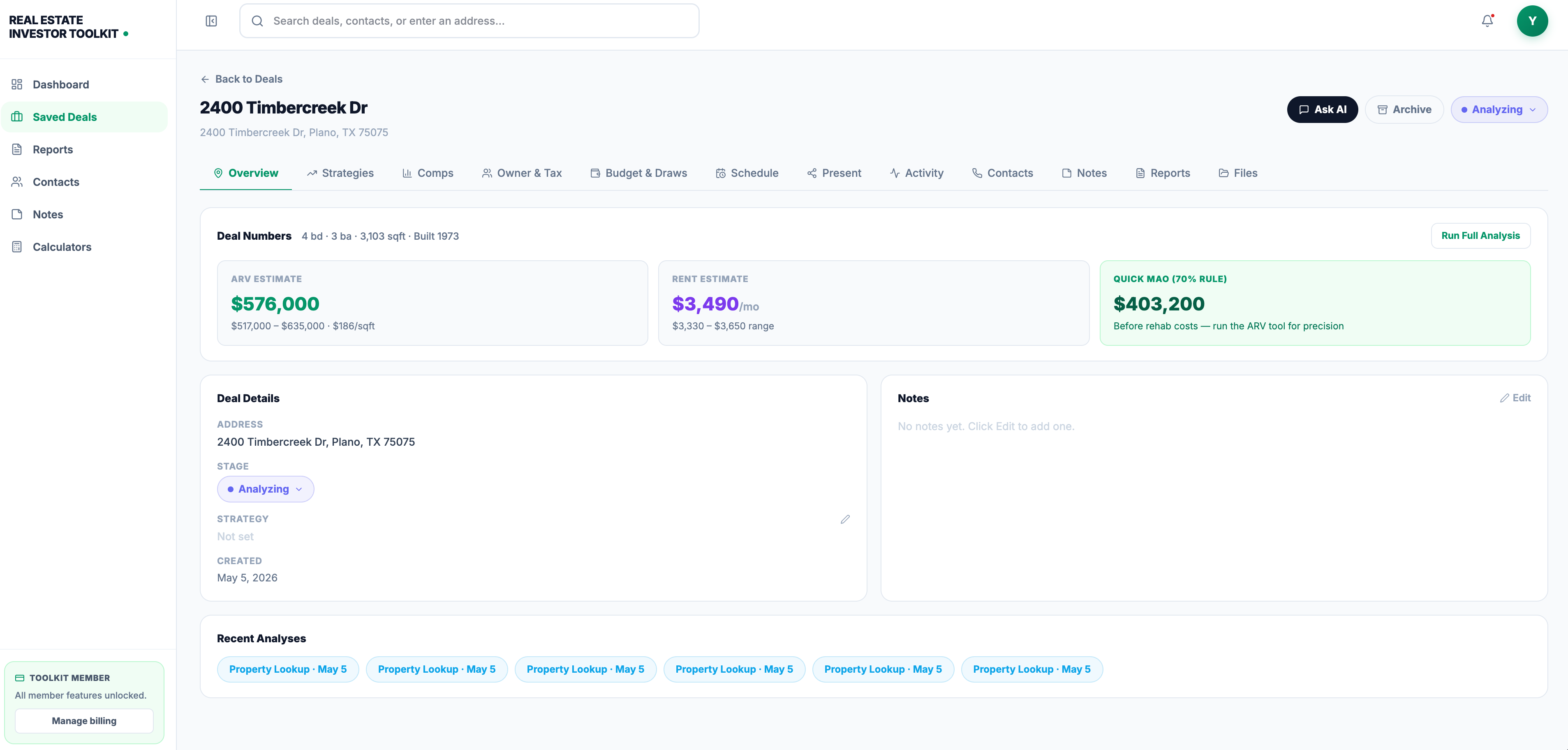
Our free calculators need no sign-up, so you can check an ARV, a maximum offer or a rehab budget in minutes. When you are working several deals at once, we designed the paid plan to bring reports, saved pipelines, property data and an AI deal advisor into one place, so you are not juggling separate subscriptions.
Start with the number the lender will care about most, then work backward to what you can pay.
Michael
Run your numbers before you apply
Start with our free tools, which need no sign-up. They cover ARV, rehab costs, rental cash flow and BRRRR scenarios. When you want unlimited reports, saved deal pipelines, owner data and AI deal insights, the full plan is $39.99 per month. See pricing or open the free tools.
For financing scenarios, our investment property financing calculator helps you compare loan structures side by side.
FAQ
What is an ARV loan?
An ARV loan is a common name for fix-and-flip or rehab financing that uses a property’s projected after-repair value as one of its sizing limits. It is not a single standardized product. The lender also looks at cost, current value, your experience, the scope of work and your exit plan.
How much of ARV will a lender finance?
It depends on the lender and your experience. Published ranges run from 60% to 75% of ARV, and the lower of the ARV limit and any cost-based limit controls. Ask your lender for its current cap and how it defines the value.
Who determines the ARV, me or the lender?
The lender does, usually through an appraisal that reports the as-is value and the value once the work is complete. Your own estimate helps you set an offer and prepare your comps, but the appraised figure drives the loan.
Can I use an ARV loan on an investment property?
Yes. Hard-money and private lenders focus on investors. On the conventional side, Fannie Mae’s HomeStyle Renovation product matrix lists one-unit investment properties as eligible, with renovations to be completed within 15 months of closing. Terms and eligibility rules differ by lender, so confirm yours.
Sources
- CoreVest: After-repair value and ARV loans
- New Silver: How to calculate the maximum loan amount
- Fannie Mae Selling Guide: HomeStyle Renovation eligibility
- Fannie Mae: HomeStyle Renovation
- Fannie Mae: HomeStyle Renovation product matrix
- RCN Capital: ARV loans explained
- Builder Finance: Fix-flip matrix
- Nav: Rehab loans for investors
- Lima One: Calculating ARV for fix and flip loans
- Pimlico Capital: Hard money loan requirements
- LendingStreet: ARV loans
- Cape Henry Capital: Fix-and-flip loans
- Willowbrook Capital: Hard money loan requirements
- Hard Money Bankers: ARV mistakes
- LendEDU: What ARV means
- Simple Lending: How private lenders value ARV
- BD Nationwide: How a fix and flip loan works
- AM Exteriors: Roofing and siding financing