Appraisal Gap Strategies for Real Estate Investors

An appraisal gap happens when the appraised value comes in below the price you agreed to pay. Your strategy comes down to four moves: cover the gap with a capped amount of cash, ask the seller to cut the price, challenge the appraisal with better comps, or walk away under your contingency. Which one is right depends on one thing: whether the deal still works at the appraiser’s number. This guide shows how to set that limit before you make an offer and how to rerun your numbers when a low appraisal lands.
TL;DR
- An appraisal gap is the purchase price minus the appraised value. Lenders base the loan on the lower figure, so you cover the difference or change the deal.
- Your main options are a capped gap clause, a price renegotiation, a reconsideration of value request, a financing change, or cancelling under your contingency.
- Set a maximum gap you will cover before you write the offer. Subtract down payment, closing costs and reserves from your available cash.
- Treat a low appraisal as new data. Rerun ARV, maximum allowable offer (MAO), rehab budget and rental cash flow before you decide.
- Waiving the appraisal contingency removes your exit. Only do it with real cash reserves and strong comps.
Table of Contents
- What an appraisal gap is and why investors run into it
- How a low appraisal hits your financing and your contract
- A worked example: what the gap really costs you
- The main appraisal gap strategies
- Waiving the appraisal: when it makes sense, and when it doesn’t
- How to challenge a low appraisal with comps
- Rerun your numbers when the appraisal comes in low
- A pre-offer checklist to reduce gap risk
- Perspective: why we build the math before the offer
- Put the numbers in before you bid
- FAQ
- Sources
What an appraisal gap is and why investors run into it
An appraisal gap is the shortfall when a property’s appraised value is lower than the agreed purchase price. It shows up most in competitive markets where low supply pushes prices up. Bidding wars add to it. One real estate broker quoted by Business Insider describes a high chance a property will not appraise at the contract price as a major risk of bidding wars.
Investment properties have their own version of the problem. Investor competition, speculative expectations or limited inventory can push purchase prices away from documented sales and income data. The same source frames a value gap as a signal of how current transaction data compares with your pricing assumptions, not as a verdict on the deal itself. That is a useful way to read it. The appraiser is not telling you the property is bad. The appraiser is telling you what closed sales support.
Think of ARV the way a cook thinks about a meal. You buy the ingredients (the house plus the rehab) and sell the finished dish (the repaired home). If the appraiser values the dish lower than you expected, the ingredients cost too much for that menu price.
How a low appraisal hits your financing and your contract
Two things are affected: how much the lender will lend, and what your contract lets you do.
Financing. A mismatch between appraised value and price can change how much the lender allows you to borrow. Lenders lend against a percentage of the lower of price or appraised value, so a lower appraisal shrinks the loan and the difference lands on your cash.
Contract. An appraisal contingency is optional. When you include it, the sale becomes conditional on the values lining up. It gives you an exit: you can typically terminate and, depending on the terms, often recover your earnest money if the property does not appraise at the agreed value. The same page quotes a Realtor and appraiser who calls the contingency fundamental, because without it you face either an unplanned shortfall or the loss of your deposit.
The consumer guidance from the CFPB is clear on one point: your contract’s actual contingency and cancellation terms control what happens next. Read your contingency language and deadlines before you need them, not after the appraisal arrives.

A worked example: what the gap really costs you
The cleanest way to see the exposure is simple arithmetic. Gap exposure is the purchase price minus the appraised value. The most you can responsibly cover is your available cash minus the down payment, estimated closing costs and required reserves.
Here is an illustrative single-family rental purchase. These numbers are examples, not market data, and your lender’s loan-to-value (LTV) limit may differ.
| Item | Amount |
|---|---|
| Agreed purchase price | $200,000 |
| Appraised value | $190,000 |
| Gap (price minus appraisal) | $10,000 |
| Planned loan at 80% LTV of price | $160,000 |
| Loan at 80% LTV of appraised value | $152,000 |
| Extra cash needed at the same LTV | $8,000 |
| Extra cash if you also pay the whole gap on top of your down payment | up to $10,000 |
In this example the lender caps the loan at $152,000. You still owe the seller $200,000, so your cash at closing rises from $40,000 to $48,000. You also now own a property that an appraiser says is worth $190,000 at a $200,000 basis. That $10,000 is not a cost you can recover through the loan. It reduces your equity on day one.
Now the reserve check. Say you have $60,000 in liquid cash. Down payment ($40,000), closing costs ($6,000) and reserves ($10,000) take $56,000. Your realistic gap capacity is about $4,000, not $10,000. That number goes in your offer, before you fall in love with the house.

The main appraisal gap strategies
1. Keep the appraisal contingency
The contingency is your cheapest protection. It costs you nothing in cash and gives you a clean way out. In a hot market it can make your offer less attractive, so many investors pair it with another tool below instead of dropping it.
2. Add a capped appraisal gap clause
An appraisal gap coverage clause limits the gap you agree to cover to a defined amount and keeps your option to renegotiate or cancel if the gap goes above the cap. For an investor this is the most useful middle path. Sellers see you will close even if the appraisal is a little short, and you have a hard ceiling.
Set the cap from your numbers, not from the competition. Use the lower of two figures: the cash you can spare after reserves, and the amount at which the deal stops meeting your return targets. If the second figure is lower, that is your cap even if you have more cash.
3. Negotiate the price
The CFPB advises you to get a copy of the appraisal and ask the seller to reduce the price, and to consider cancelling if the seller will not. Bring the appraisal and your three to five best closed comps. Sellers who have seen a lender-ordered value are often more flexible than they were at the offer stage, especially if other buyers would face the same appraisal.
A common compromise is to split the gap. Offer to cover part in cash and ask the seller to drop the price by the rest.
4. Challenge the appraisal
See the next section. It costs little and can recover the whole gap if the appraiser missed something.
5. Adjust the financing
If you want to keep the deal, you can rework the loan to free cash. One lender’s guidance suggests switching to a lower down payment option to free cash for the shortfall, or using lump-sum PMI that can be financed. In its example, financed lump-sum PMI added only $16 to the monthly housing payment. That is one lender’s example, so run your own quote. And any option that lowers your down payment also lowers your equity and can raise your monthly cost, so rerun cash flow.
If your plan is a BRRRR, the refinance also depends on appraised value. Our guide to underwriting BRRRR refinance risk shows how to stress the numbers, and the cash-out refinance math page shows when pulling equity helps.
6. Walk away
Buying above appraised value is risky because you may pay more than the property is worth. If the gap is large, your comps agree with the appraiser, and the seller will not move, walking away under your contingency is a legitimate business decision. Losing a deal is cheaper than owning one that does not pencil.
Waiving the appraisal: when it makes sense, and when it doesn’t
A full appraisal waiver means you agree to cover any gap in cash and have no appraisal-based exit. That source considers it appropriate only for buyers with significant cash reserves or strong comparable-sales support. Another guide agrees that waiving the contingency is risky and that a gap clause can cap your cash exposure.
Before you consider a waiver, run this check:
- Pull three to five closed comps and adjust them the way an appraiser would. Our comps process and sales comparison guide walk through it.
- Calculate the deal at your own conservative value, not the list price.
- Confirm that you could pay the worst-case gap from cash above your reserves.
- If any answer is no, use a capped clause instead of a waiver.
How to challenge a low appraisal with comps
You have a right to see the report. The FDIC says the lender must provide the appraisal as soon as reasonably possible and no later than three days before closing. The same page says you can ask whether the lender has a reconsideration process and then submit factual information, such as relevant comparable sales or corrections.
That process is a reconsideration of value (ROV). It works best with verifiable evidence: factual errors in the report, or better, supportable comparable sales the appraiser did not consider. Fannie Mae’s 2024 policy standardizes parts of lenders’ borrower-initiated ROV procedures. If a lender validates a request, it must send the appraiser supporting information, including up to five comparable properties.
To build a request that gets taken seriously:
- Check the facts first. Square footage, bedroom and bath count, lot size and condition ratings are the easy errors to prove.
- Pick comps the appraiser could have used. Closed sales, similar size and age, close in distance and recent. Pending listings and asking prices are not evidence.
- Adjust for differences. If your comp has a renovated kitchen and the subject does not, the numbers need to show that. See our guide to adjusting comps for repairs.
- Keep it factual. No arguments about what the house is worth to you. Cite sale dates, prices and the correction you are asking for.
- Know how appraisers work. Understanding how appraisal methodology works helps you tell a real error from a judgment call.
If you are buying in a state where sale prices are not public, comp sourcing needs extra care. See how to pull comps in non-disclosure states.
Freddie Mac notes that you can use the appraisal report to help decide whether the price is acceptable. Read it for that purpose even when you plan to challenge it.
Rerun your numbers when the appraisal comes in low
A low appraisal rarely changes only one number. Work through the chain in this order.
ARV
If you are buying a distressed property, the appraisal is often an as-is value, and your ARV is separate. Still, a low as-is value is a signal that your comps may be too generous. Rebuild ARV from three closed comps at the conservative end. Our ARV calculator lets you try base, lower and higher scenarios, and the down-market ARV scenarios guide shows how to stress them.
MAO
MAO is the highest price you can pay and still hit your profit target. One common form is ARV times your chosen percentage, minus repairs, minus your fee or margin. If ARV drops by $10,000 and your percentage is 70%, MAO drops by $7,000. That tells you how much price reduction you should ask the seller for. See what MAO is, how ARV and MAO differ, and the wholesale offer formula if you assign contracts.
Rehab budget
A gap uses cash you may have set aside for repairs. Rebudget with a rehab cost calculator and our rehab cost guide so the extra closing cash does not come out of contingency money for the work.
Rental cash flow
A smaller loan or a financed PMI payment changes monthly debt service. A higher cash invested figure lowers cash-on-cash return even if the rent is the same. Recalculate with the actual loan terms, not the original ones. If it no longer clears your minimum return, that is your walk-away line.
If you are new to this sequence, how to analyze your first deal lays out the steps. Also see appraisal vs. BPO for how lender valuation differs from a broker opinion.
A pre-offer checklist to reduce gap risk
- Run comps before you offer, not after. If your comps support less than the asking price, your offer should too.
- Decide your maximum gap cash and write it down.
- Keep the contingency, or cap the gap clause at that figure.
- Ask your lender how they handle ROV requests and how long they take.
- Keep your timeline realistic. Appraisal, ROV and renegotiation all take days.
- Confirm your earnest money terms. Cancellation costs depend on your purchase contract.
Perspective: why we build the math before the offer
We built Real Estate Investor Toolkit around a simple belief: most appraisal gap pain starts with the offer, not the appraisal. When an investor starts from a list price, the appraiser’s number feels like a surprise. When an investor starts from verified comps, a conservative ARV and a calculated MAO, the same number is a data point.
That is why our free calculators need no sign-up. You can test a deal in minutes: pull comps, set ARV, add rehab, and see the highest price that still works. Then you can decide your gap cap with real numbers instead of competitive pressure.
Our approach is designed to help you catch the two common errors behind most gaps: overestimating what a property will sell or appraise for, and underestimating the repair costs that eat into your margin. When you keep both under control, a $10,000 gap is a manageable line item, not a deal-killer.
Michael
Put the numbers in before you bid
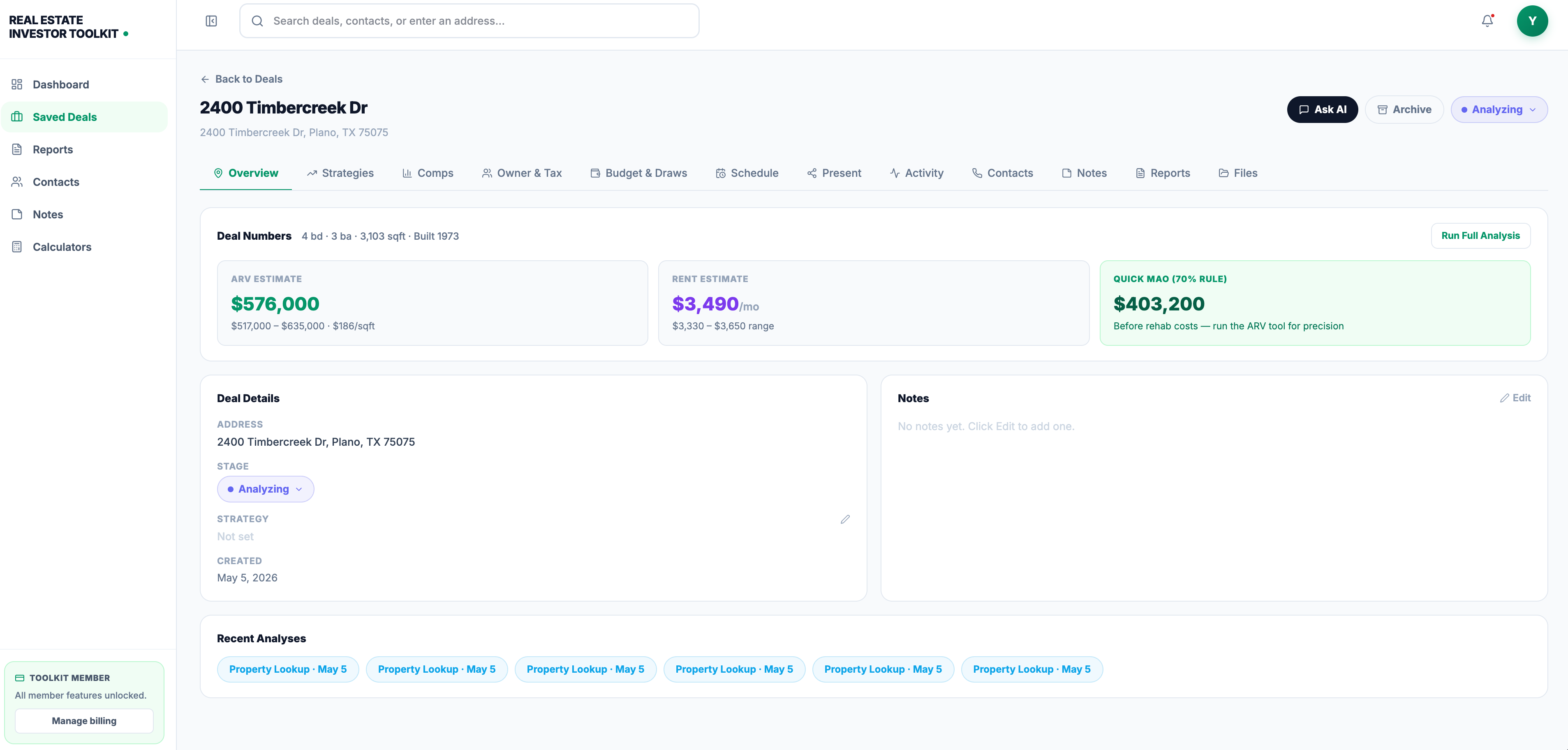
Start with the free calculators to check ARV, MAO and rehab on any deal with no sign-up. If you analyze several deals a month and want saved pipelines, unlimited reports, advanced property data and AI deal insights in one place, the Real Estate Investor Toolkit plan is $39.99 per month. You can see what is included on the pricing page.
FAQ
What is the difference between an appraisal gap and an appraisal gap clause?
The gap is the shortfall between the appraised value and your purchase price. The clause is the contract term in which you agree to cover that shortfall up to a stated dollar amount. If the gap exceeds the cap, you can usually renegotiate or cancel, depending on your contract.
Can I get my earnest money back if the appraisal is low?
Often yes, if you kept an appraisal contingency and acted within its deadlines. The result depends on the terms of your purchase contract, so read the contingency and cancellation language before you rely on it. If you waived the contingency, your deposit may be at risk.
Can the lender or appraiser change the value after I send comps?
Sometimes. Many lenders have a reconsideration of value process, and you can ask yours how it works. The best requests point to factual errors or closed comparable sales the appraiser did not consider. There is no guarantee the value changes.
How much of a gap should I be willing to cover?
Use the lower of two limits: the cash left after your down payment, closing costs and reserves, and the amount at which your return drops below your target. Write that number into your offer before you negotiate. Rerun ARV, MAO and cash flow with the extra cash included.
Sources
- What Is an Appraisal Gap? (Realtor.com)
- What Is an Appraisal Gap? (Business Insider)
- Appraisal For Investment Property: Value And Risk
- Consumer Guide: The Appraisal Process (NAR)
- What is an appraisal contingency?
- Appraisal Gap Strategy for Buyers
- Appraisal Gap Coverage vs Waiver Guide
- My appraisal is less than the sale price (CFPB)
- What Happens if the Appraisal Is Lower Than the Offer?
- We’re Seeing Lots of Low Appraisals; Here Are Your Options
- Understanding Appraisals and Why They Matter (FDIC)
- What To Do When the Appraised Value Is Lower Than the Purchase Price
- Appraiser Update June 2024 (Fannie Mae)
- What Homebuyers Can Expect with an Appraisal (Freddie Mac)