AI for Real Estate: A Practical Playbook for Professionals

AI for real estate automates valuation, accelerates deal screening, and cuts operating costs — start with a focused pilot that solves one high-volume task you already do manually. The fastest path to measurable ROI is picking a single workflow, running a 30-day test with real data, and measuring the delta before expanding.
Here is where to begin in the next 7–30 days:
- Run an AI-assisted ARV estimate. Pull comps through a tool like Real Estate Investor Toolkit and let the AI assistant cross-check your numbers against verified market data. You will spot pricing gaps in minutes, not hours.
- Audit one repetitive document task. Lease abstraction, listing descriptions, and maintenance work orders are the three tasks McKinsey identifies as early, high-impact targets for AI automation.
- Check your compliance baseline. The National Association of REALTORS® recommends a uniform federal AI framework precisely because state-by-state rules on data privacy and fair housing vary enough to create real liability for brokers and agents who adopt AI without a policy in place.
Key Takeaways
AI for real estate delivers the most measurable value when you pilot it on a single, high-volume task with a clear baseline metric before expanding to broader workflows.
| Point | Details |
|---|---|
| Start with one workflow | Pilot AI on your highest-volume task first — deal screening, lease abstraction, or maintenance triage — and measure time saved against a pre-pilot baseline. |
| Compliance is not optional | Audit AI tools for fair-housing bias and data privacy compliance before deployment; NAR recommends a written AI use policy for every office. |
| RAG reduces hallucination risk | Retrieval-Augmented Generation grounds AI answers in your actual MLS or lease data, making outputs far more reliable than plain generative models for property-specific questions. |
| ROI follows a simple formula | Measure time per task, apply your fully loaded staff cost, and compare to tool cost; conservative estimates show material savings at 15+ deals per week. |
| Real Estate Investor Toolkit | Provides ARV, rehab, MAO, BRRRR, and rental calculators with a built-in AI assistant — a ready-made pilot for investors who want AI-assisted deal analysis without a complex setup. |
Table of Contents
- What can AI actually do for real estate professionals?
- How do agents, investors, and property managers use AI day-to-day?
- Which AI tool categories should you consider, and how do you choose?
- How do you pilot and scale AI in your real estate business?
- What are the regulatory and legal risks of AI in U.S. real estate?
- How do you measure ROI from an AI project?
- How Real Estate Investor Toolkit applies AI to investor deal analysis
- Where AI helps most and what to watch carefully
- Real Estate Investor Toolkit gives you a ready-made AI pilot
- Sources
What can AI actually do for real estate professionals?
The term “AI for real estate” covers four distinct capability families, each requiring different data and producing different outputs. Understanding the map prevents you from buying a tool that solves the wrong problem.
| AI Capability | Required Data Inputs | Real-World Result |
|---|---|---|
| Predictive analytics | Historical sales, tax records, demographic trends, macro rates | Forecast price movement, flag off-market leads, score neighborhoods by investment potential |
| Computer vision (CV) | Property photos, satellite imagery, 3D scans | Automated condition scoring, renovation cost estimates, virtual staging |
| Generative AI / NLP | Listing data, agent notes, marketing briefs | Listing copy, email sequences, offer summaries, chatbot responses |
| Retrieval-Augmented Generation (RAG) | MLS feeds, lease documents, transaction records | Accurate document Q&A, lease abstraction, deal-specific valuation support |
Predictive analytics is the most mature capability. Feed it three to five years of local sales data plus current rate and inventory trends, and the model surfaces which zip codes are likely to appreciate and which properties are priced above their likely sale price. Computer vision adds a layer that spreadsheets cannot: a model trained on millions of property photos can score roof condition, estimate flooring replacement cost, and flag deferred maintenance from listing images alone. Industry vendors have built scalable condition-scoring and renovation-estimate products on exactly this approach.
Generative AI handles the language-heavy work. Give a well-prompted model a property address, three comps, and a target buyer profile, and it produces a listing description, a social caption, and a follow-up email sequence in under two minutes. That is not a hypothetical — Matterport documents generative marketing and immersive visualization as practical, near-term applications already driving conversion for listing agents.
RAG deserves special attention because it solves the hallucination problem that makes plain large-language models unreliable for property-specific questions. RAG pairs your actual MLS feed or lease database with the language model, so the model answers from your data rather than from its training set. The result is a chatbot that can accurately answer “What is the current cap rate on my 12-unit in Phoenix?” without fabricating a number.
How do agents, investors, and property managers use AI day-to-day?
Agents and listing brokers
An agent’s highest-volume tasks are writing listing content, responding to buyer inquiries, and scheduling showings. AI handles all three. A generative model trained on your past listings can draft MLS descriptions that match your voice in seconds. An NLP-powered chatbot on your website qualifies inbound leads 24/7, asking pre-screening questions and routing serious buyers to your calendar automatically.
Mini-case: A listing agent using AI-generated virtual staging through a tool like StageSnap can present a vacant property as fully furnished in under an hour, at a fraction of traditional staging costs, and test multiple design styles to match different buyer demographics.
Investors
For investors, the core job is screening deals fast and pricing them accurately. Predictive analytics flags properties where the asking price sits above likely ARV before you spend time on a site visit. Computer vision estimates rehab scope from listing photos, giving you a rough cost range before you order a formal inspection.

Mini-case: An investor running a fix-and-flip operation uses an AI assistant to cross-reference three comp sets, apply a condition adjustment from photo scoring, and output a maximum allowable offer (MAO) in about four minutes. The same analysis done manually takes 30–45 minutes per deal. At 20 deals screened per week, that is roughly 8–13 hours recovered.
Property managers
McKinsey’s analysis points to maintenance triage and lease abstraction as two of the clearest early wins for AI in real estate operations. A maintenance triage model reads incoming tenant requests, classifies urgency, assigns the right vendor category, and drafts the work order — all before a human reviews it. Lease abstraction pulls key dates, rent escalation clauses, and tenant obligations from a 40-page commercial lease in seconds.

Brokers and team leaders
Brokers benefit most from portfolio-level analytics and agent performance data. AI can aggregate transaction data across a team, identify which lead sources convert at the highest rate, and flag agents whose pipeline has stalled. NLP document processing also speeds contract review, pulling contingency dates and key clauses so transaction coordinators spend less time reading and more time managing.
Pro Tip: Before deploying any AI tool to your team, map the three tasks that consume the most hours per week. Pilot AI on the single highest-volume task first. A narrow win builds internal confidence faster than a broad rollout that touches everything at once.
Which AI tool categories should you consider, and how do you choose?
The market currently offers five distinct tool categories. Each fits a different workflow, and picking the wrong category is the most common implementation mistake.
1. Automated Valuation Models (AVMs) pull MLS, tax, and deed data to estimate property value. They are fast and cheap but lose accuracy in thin markets with few recent comps. Use them for initial screening, not final pricing.
2. Computer vision platforms analyze photos and satellite imagery to score condition and estimate renovation costs. They work best when you have consistent, high-quality photo inputs. Thin or low-resolution photo sets degrade output quality significantly.
3. Generative AI / NLP tools produce listing copy, email sequences, chatbot responses, and document summaries. They require clear prompts and a human review gate — raw output from any generative model should never go directly to a client or MLS without an agent check.
4. RAG-powered document agents connect your lease library, transaction files, or MLS feed to a language model so you can ask plain-English questions and get answers grounded in your actual data. These require a data pipeline setup but dramatically reduce hallucination risk.
5. Predictive analytics platforms score leads, forecast price movement, and identify off-market opportunities. They need at least 12–24 months of historical transaction data to produce reliable outputs.
Selection checklist
Before signing any contract, confirm the tool meets these criteria:
- Data connectors: Does it integrate with your MLS, CRM, or property management system, or does it require manual data uploads?
- Privacy controls: Where is your client and property data stored? Is it used to train the vendor’s shared model?
- Human-review gates: Does the workflow require a licensed professional to approve AI outputs before they reach a client or a public listing?
- Audit trail: Can you export a log of AI-generated outputs for compliance recordkeeping?
- Fair-housing guardrails: Does the vendor document how the model was tested for demographic bias?
Questions to ask every vendor
- What data sources train your model, and do you have rights to all of them?
- How do you handle a data breach involving client PII?
- What is your SLA for model accuracy degradation alerts?
- Can I export my data if I cancel?
- Have you conducted a disparate-impact analysis on your valuation or scoring outputs?
How do you pilot and scale AI in your real estate business?
A structured pilot protects you from the two most common failure modes: buying a tool that does not fit your data, and rolling out too broadly before you know what works.
-
Discovery (Week 1–2): Identify the one workflow consuming the most staff hours. Map the current process step by step. Document the data inputs it requires and where that data lives today (MLS, spreadsheet, CRM, paper files).
-
Data preparation (Week 2–4): Clean and centralize the data the tool needs. For an AVM pilot, that means pulling 12 months of local comps into a consistent format. For a lease abstraction pilot, that means digitizing your lease library. Skipping this step is the single biggest reason pilots fail.
-
Scoped pilot (Week 4–8): Run the tool on a small, representative sample — 20–30 deals, 10–15 leases, or one month of maintenance requests. Do not change anything else in the workflow during this period.
-
Human review layer (ongoing during pilot): Every AI output gets reviewed by a licensed professional or experienced staff member before it is acted on. Log every correction. Those corrections become your accuracy baseline.
-
Metric tracking (Week 8–10): Measure the delta on your target KPI (time per task, accuracy rate, lead conversion, cost per output). Compare to your pre-pilot baseline.
-
Scale decision (Week 10–12): If the pilot shows a measurable improvement on your target KPI, expand to the full workflow. If not, diagnose whether the issue is data quality, tool fit, or process design before investing further.
Cost buckets to plan for
- Tool licensing: Most SaaS AI tools for real estate run $50–$500/month for individual or small-team plans; enterprise platforms with MLS integrations typically start at $1,000+/month.
- Integration and data prep: Budget 10–20 hours of staff or consultant time to connect data sources and clean inputs for a first pilot.
- Training: Plan for 2–4 hours of team onboarding per tool, plus ongoing calibration as the model updates.
Governance checklist
- Define who has permission to access AI-generated outputs and act on them.
- Require human sign-off before any AI output reaches a client, a listing, or a legal document.
- Set a quarterly review cadence to audit model accuracy and check for output drift.
- Document your AI use policy in writing and share it with your team before go-live. The SANDBOX Act (S.2750) represents federal legislative movement toward structured AI testing frameworks — staying current on federal and state policy changes should be part of your quarterly review.
What are the regulatory and legal risks of AI in U.S. real estate?
The three biggest U.S.-specific risks are fair-housing violations from biased AI outputs, data privacy liability from mishandling client PII, and copyright exposure from using listing photos or MLS content to train or fine-tune models. All three are live risks today, not theoretical ones.
The National Association of REALTORS® has called for a uniform federal AI framework specifically because the current patchwork of state laws creates inconsistent compliance obligations for brokers operating across state lines. Until federal standards arrive, you need a state-by-state review for any AI tool that processes client data or generates property-related content.
Compliance checklist
- Fair housing: Test any AI scoring, ranking, or recommendation tool for disparate impact across protected classes (race, color, national origin, religion, sex, familial status, disability) before deployment. Document the test.
- Data privacy: Confirm your AI vendor’s data processing agreement complies with applicable state privacy laws (California’s CCPA, Virginia’s CDPA, and others). Collect only the data the tool actually needs.
- Listing content and copyright: Do not feed copyrighted MLS photos or listing text into a model you do not have explicit rights to train on. NAR’s guidance specifically flags this as a risk area.
- Disclosure: Tell clients when AI has materially assisted in producing a valuation, a listing description, or a contract summary. Document that disclosure.
- Recordkeeping: Retain AI-generated outputs and the human review decisions made on them for the same period you retain other transaction records.
Pro Tip: Draft a one-page AI use policy for your office before you deploy any tool. It should cover: which tasks AI may assist with, which outputs require human review before use, how client data is handled, and how you disclose AI assistance to clients. NAR’s policy resources are a practical starting point.
Legislative activity is accelerating. Beyond the SANDBOX Act, bills like H.R.8516 (American Leadership in AI Act) signal that transparency and training-data rules are coming at the federal level. Build your compliance framework to accommodate change, not just current requirements.
Pro Tip: For fair-housing risk specifically, run a simple audit: take 50 AI-generated valuations or lead scores and check whether outputs differ systematically by neighborhood demographics. If they do, pause and investigate the model’s training data before going live.
How do you measure ROI from an AI project?
Measuring AI value requires a pre-pilot baseline. Without it, you cannot prove the tool did anything. Set your KPIs before the pilot starts, not after.
KPI checklist
- Time to lead response: Minutes from inquiry to first agent contact (target: under 5 minutes with AI triage vs. industry average of several hours)
- Valuation accuracy: Percentage variance between AI-estimated ARV and final sale price (target: within 5% on 80%+ of estimates)
- Conversion lift: Lead-to-appointment or lead-to-offer rate before and after AI-assisted nurturing
- Cost per automated task: Dollar cost of AI-processed output vs. staff time at fully loaded hourly rate
- Maintenance resolution time: Hours from tenant request to work order dispatch (property managers)
Simple ROI example
Assumption: An investor screens 15 deals per week manually. Each deal takes 35 minutes to analyze (comps pull, ARV estimate, MAO calculation, rehab rough-scope). Fully loaded staff cost is $40/hour.
These are conservative, labeled assumptions. Your actual numbers will vary based on deal volume, staff cost, and tool pricing. The point is the framework: measure time per task, apply your real cost rate, and compare to tool cost. AI in property management and investing follows the same logic — the ROI case is clearest when you attach it to a specific, measurable task.
Reporting cadence
Report AI KPIs monthly during the first quarter of any deployment. After 90 days, shift to quarterly reviews unless accuracy degrades or a compliance issue surfaces. Share results with your team — transparency about what the tool does and does not do well builds the internal trust that makes scaling possible.
How Real Estate Investor Toolkit applies AI to investor deal analysis
Here is a concrete walkthrough of how an investor uses Real Estate Investor Toolkit’s calculators and AI assistant to move from raw lead to a defensible offer in under 10 minutes.
-
Enter the property address. The platform pulls available property data and surfaces comparable sales in the target market. No sign-up is required for the initial analysis.
-
Run the ARV calculator. The tool applies comp weighting based on proximity, square footage, and condition adjustments. The AI assistant flags if the comp set is thin or if one outlier comp is skewing the estimate.
-
Estimate rehab costs. The rehab cost calculator walks you through a line-item scope — roof, HVAC, kitchen, baths, flooring — and outputs a total estimated cost with a conservative and aggressive range. This is the input most investors get wrong when they rely on gut feel alone.
-
Calculate the MAO. With ARV and rehab cost in hand, the platform computes your maximum allowable offer using your target profit margin and financing assumptions. The AI assistant can explain why the MAO changed if you adjust any input.
-
Review and save. The deal is saved to your pipeline with all inputs logged. You can pull it up on a follow-up call, share it with a partner, or export it for lender review.
The practical advantage here is speed with defensibility. A deal that used to require 30–45 minutes of manual comp research and spreadsheet work now takes under 10 minutes, with every assumption documented and reviewable. For an investor screening 15–20 deals per week, that time recovery is material.
The platform also supports BRRRR strategy modeling and rental cash flow analysis, so the same AI-assisted workflow extends to buy-and-hold and refinance scenarios, not just fix-and-flip.
Where AI helps most and what to watch carefully
The clearest near-term wins in AI for real estate are valuation automation, lead triage, and maintenance triage. These three tasks share a common profile: high volume, repetitive inputs, and a measurable output that a human can verify. That combination is exactly where AI earns its cost.
What concerns me more than the technology itself is the confidence gap. Professionals who see a clean AI output — a polished ARV estimate, a well-written listing description, a scored lead list — tend to trust it more than they should, especially early in a deployment when the model has not yet been calibrated to local market conditions. The tool is only as good as the data behind it, and in thin markets or unusual property types, that data is often sparse.

Bias in valuation models deserves more attention than it currently gets. A model trained predominantly on transactions in majority-white neighborhoods will systematically undervalue properties in minority neighborhoods, not because of any intentional design, but because the training data reflects historical patterns of underinvestment. That is a fair-housing risk and an accuracy risk simultaneously. Running a disparate-impact audit before you rely on any AI valuation tool is not optional — it is the professional standard.
On the regulatory front, watch the federal legislative calendar. The SANDBOX Act and related bills signal that structured AI governance frameworks are coming. Firms that build compliance habits now will adapt faster than those who treat it as a future problem.
Pro Tip: Start with AI for deal screening or maintenance triage, not for client-facing communications. Internal workflows give you a controlled environment to calibrate the tool and catch errors before they affect a client relationship or a transaction.
Real Estate Investor Toolkit gives you a ready-made AI pilot
Most investors spend their first AI pilot chasing integrations and cleaning data. Real Estate Investor Toolkit removes that friction. The calculators connect directly to verified market data, the AI assistant is built into the deal analysis workflow, and the free tier lets you run your first analysis without a subscription commitment.
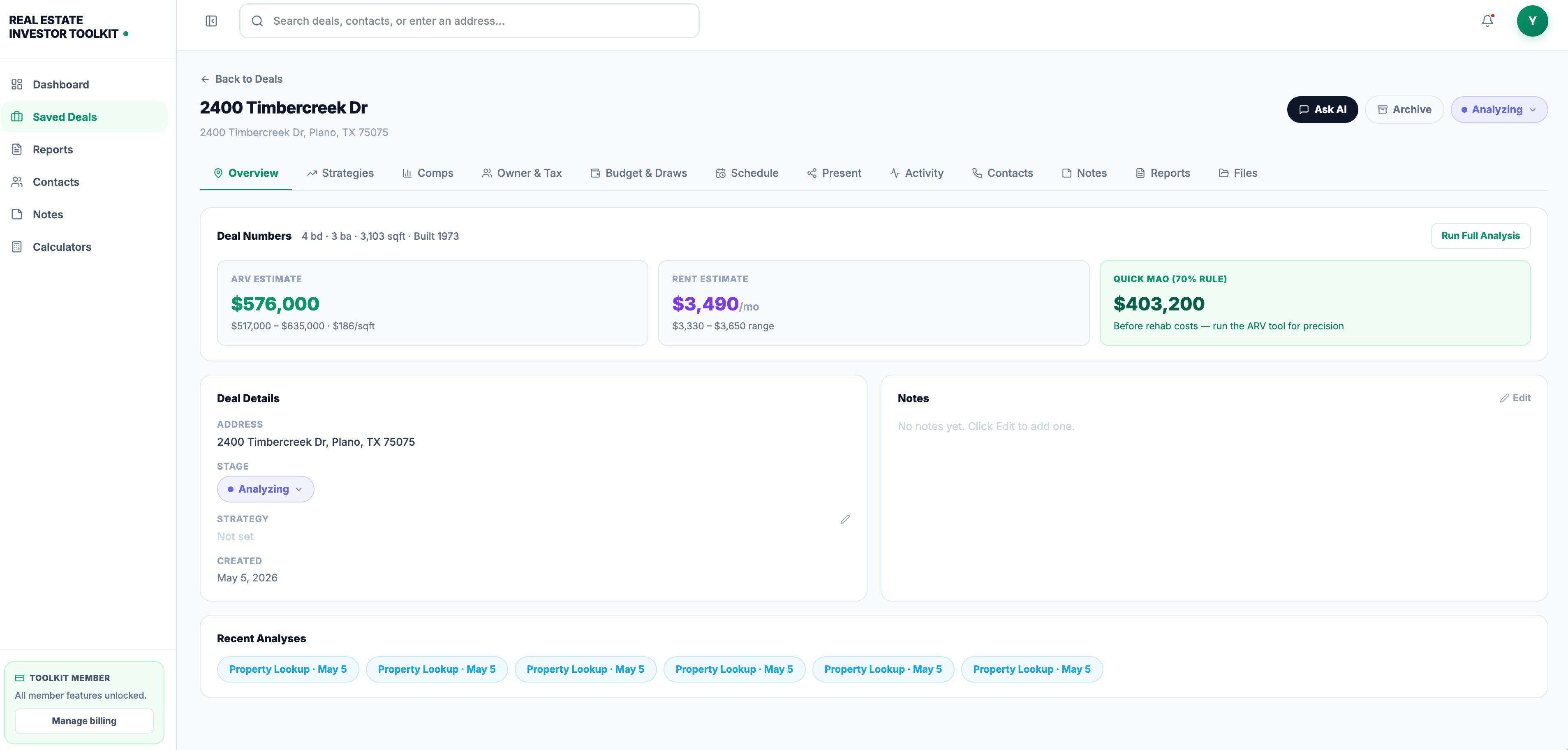
Here is a three-step pilot you can run this week:
- Pick three active leads and run each through the ARV calculator and rehab cost estimator. Record the time it takes and compare the outputs to your manual estimates.
- Use the AI assistant to stress-test your MAO on each deal. Ask it what changes if rehab costs run 15% over budget or if ARV comes in 5% below estimate.
- Review the delta. If the AI-assisted analysis surfaces a pricing gap or a risk you missed manually, you have your ROI case. Scale from there.
The investing guides and frameworks section gives you the methodology context to interpret what the tools produce — useful if you are newer to deal analysis or want to train a team member. Visit Realestateinvestortoolkit to run your first analysis now, no account required.
Sources
- Artificial Intelligence (AI) in Real Estate
- Where AI is creating real value in real estate
- 8 Transformational Applications of AI in Real Estate
- Congress