4 Step Investor Workflow: Absentee Owner Meaning and Free Tools

An absentee owner is someone who holds title to a property but does not live at or actively manage it. This shows up most often with rental investment properties, vacation homes, and real estate inherited from family members. The practical consequences follow quickly: someone else has to handle maintenance and tenant needs, tax rules shift depending on how the property is used, and a poorly managed absentee property can affect the look and safety of an entire block.
TL;DR:
- Absentee owners often rely on local property managers, contractors, or remote oversight, which can lead to delayed repairs and maintenance issues.
- Owning through LLCs or trusts influences decision-making speed and liability protection but does not change the core absentee status.
- Deductible expenses for absentee rentals include mortgage interest, property taxes, insurance, repairs, and depreciation, regardless of physical presence.
- Public records such as tax mailing addresses and deed information help identify absentee owners, along with signs like overgrown lawns and accumulated mail.
- Successful absentee investments depend on trusted local management, sufficient reserves for vacancies and repairs, and careful screening of property conditions and financials.
Table of Contents
- What absentee ownership actually means and how it works
- Types of absentee owners and why the category matters
- Pros and cons of absentee ownership
- Tax and financial implications of owning from a distance
- How to find absentee owners using public records
- A practical workflow for screening absentee-owned deals
- When absentee ownership makes sense and when it doesn’t
- Try the free tools built for exactly this kind of deal
- Sources
- FAQ
What absentee ownership actually means and how it works
Ownership and occupancy are two different things, and absentee ownership is what happens when they split apart. The title holder is the legal owner of record, but a tenant, property manager, or nobody at all occupies the space day to day. That gap has to be filled somehow, and most absentee owners fill it in one of three ways: hiring a local property manager, contracting individual local tradespeople for repairs as they come up, or overseeing things remotely through phone calls, video walkthroughs, and trusted neighbors.
The ownership structure an absentee owner chooses often reflects how hands-off they want to be. Individual ownership is the simplest setup, common for someone who inherited a house or bought a single rental. An LLC adds a layer of liability protection and is popular with investors who own multiple properties, since a lawsuit tied to one property generally can’t reach the owner’s personal assets. A trust is common for estate planning or for owners who want a structured way to pass property to heirs without probate.

None of these structures change the basic fact of absentee ownership. What changes is who’s accountable, how repairs get authorized, and how quickly decisions get made when something goes wrong at 2 a.m. three states away.
Types of absentee owners and why the category matters
Not every absentee owner behaves the same way, and knowing which type you’re dealing with tells you a lot about how a property is likely to be maintained, priced, or sold.
- Individual small-scale landlords, often owning one to three properties, tend to be the most responsive to direct outreach and the most likely to sell if the property becomes a burden.
- LLCs and partnerships split decision-making across multiple stakeholders, which can slow down maintenance approvals but also means the entity is often better capitalized for repairs.
- Institutional owners and REITs operate at scale with dedicated management teams, so individual properties get less personal attention but benefit from standardized maintenance schedules.
- Partial-interest owners, such as siblings who inherited a house together, frequently face decision gridlock because no single person has full authority to act.
Understanding which category applies helps explain why one absentee-owned duplex is in great shape while another two blocks over has a collapsing gutter nobody has fixed in years. For a closer look at how absentee and owner-occupied strategies differ for investors, see this breakdown of owner-occupied versus absentee ownership.
Pros and cons of absentee ownership
Absentee ownership isn’t inherently good or bad. It’s a trade-off, and the trade-off looks different depending on whether you’re the owner, the tenant, or the neighbor next door.
- Pro: Passive income without the demands of on-site management, since a property manager or reliable contractor handles day-to-day issues.
- Pro: Geographic diversification lets an investor own property in a stronger rental market than the one they live in.
- Pro: Rental property owners can generally deduct ordinary operating expenses and depreciate the structure over time, a benefit tied to title rather than occupancy.
- Con: Deferred maintenance is a real risk when an owner isn’t physically checking on the property, and small problems can become expensive ones.
- Con: Neighbors and local governments sometimes view absentee-owned properties with suspicion, especially if upkeep slips.
- Con: Property management fees and remote oversight costs cut into the margin that made the investment attractive in the first place.
Pro Tip: Set aside a maintenance reserve equal to at least one month’s rent per year before you count on the income as fully passive.
Mitigating the downsides usually comes down to picking a property manager you trust, building that reserve fund early, and cultivating a relationship with at least one local contractor who can respond fast.
Tax and financial implications of owning from a distance
The tax code doesn’t care whether you live next door to your rental or three time zones away. Eligibility to depreciate a rental property and deduct ordinary expenses is tied to title and use, not physical presence, according to the IRS’s guidance on residential rental property.
Common deductible expenses include:
- Mortgage interest, property taxes, and insurance premiums on the rental.
- Repairs, maintenance, and property management fees.
- Depreciation on the building itself, spread over its useful life.
- A proportional share of expenses when ownership is split among multiple parties, based on percentage of interest.
A key figure to know: the IRS allows depreciation and deduction of necessary rental expenses whenever the property is used in an income-producing activity, which is the standard that matters far more than where the owner sleeps at night.
Travel expenses to check on the property carry tighter limits than most new owners expect, and the IRS draws a hard line between personal use days and rental use days when a property serves both purposes. Budgeting realistically means accounting for management fees (typically a percentage of collected rent), a vacancy reserve for the months the unit sits empty, and a cash-flow model that doesn’t assume every month goes smoothly. A rental cash-flow breakdown can help you see where these line items actually land.
How to find absentee owners using public records
Whether you’re a wholesaler building a lead list, an investor looking for a motivated seller, or a city official trying to reach a negligent property owner, the process is largely the same.
- Check the county assessor’s office for the mailing address tied to the tax bill. When it differs from the property address, that’s your first sign of absentee ownership.
- Pull the deed or title record to confirm the legal owner, watching for LLC names or out-of-state addresses that reinforce the mailing-address clue.
- Use owner-report tools or municipal APO toolkits to organize outreach, since many local governments have built structured templates for contacting absentee owners of problem properties.
Field indicators help too: overgrown lawns, accumulated mail, and boarded windows are common signs a property isn’t owner-occupied. Reach out respectfully and give the owner a clear, low-pressure reason to respond, whether that’s a maintenance concern or a purchase offer.
A practical workflow for screening absentee-owned deals
Once you’ve identified an absentee-owned property worth pursuing, the screening process follows a straightforward sequence: identify the owner, pull comps to estimate after-repair value, estimate rehab costs, model the cash flow, then reach out.
- Identify: confirm absentee status through owner records, then check occupancy details where available.
- Value: run comps and an ARV calculator to establish a realistic after-repair value.
- Estimate: use a rehab cost tool to price out the work before you make an offer.
- Model: plug numbers into a rental cash-flow calculator to see if the deal actually pencils.
Pro Tip: Run the cash-flow numbers before you contact the owner, so you already know your ceiling offer when the conversation starts.
When absentee ownership makes sense and when it doesn’t

Absentee ownership works well when you have reliable local management, a property type that doesn’t demand constant attention, and financial reserves to cover surprises. It works poorly when you’re relying on hope instead of a system, or when the property needs more hands-on attention than a remote owner can realistically provide.
Before taking this path, ask yourself three questions: Do I have someone local I trust to respond within 24 hours? Can I absorb a few months of vacancy without financial strain? And am I buying this property for cash flow, or am I buying it because it seemed like a good idea on paper?
— Michael
Try the free tools built for exactly this kind of deal
Screening an absentee-owned property from a distance is easier when you’re not guessing at the numbers. Real Estate Investor Toolkit gives you free, no-sign-up calculators for ARV, rehab costs, and rental cash flow, plus owner and absentee owner data to help you verify who you’re dealing with before you make an offer.
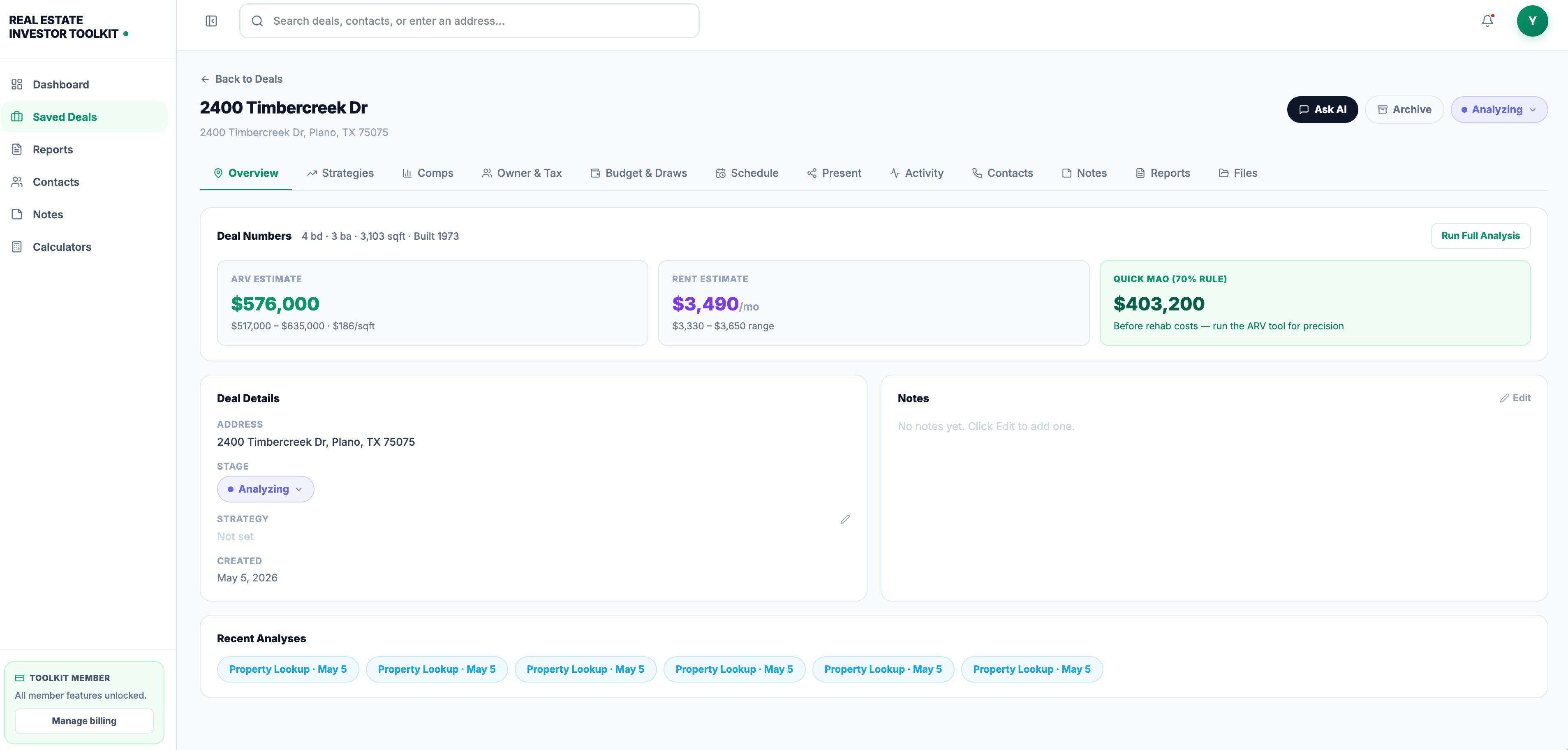
If you’re new to the workflow, start with these:
- The rental property calculator to check whether a deal’s cash flow supports the asking price.
- The ARV calculator to confirm your after-repair value before you negotiate.
- Owner reports to confirm absentee status and find a mailing address for outreach.
For remote outreach once you’ve identified an owner, some investors also look into dedicated contact solutions like a local phone number for owners managing property from abroad, which can make follow-up calls feel less like a cold approach.
For investors who want unlimited reports, saved deal pipelines, and AI-assisted deal insights on top of the free calculators, the Real Estate Investor Toolkit plan runs $39.99 per month. Start with the free tools and see how far they take your next deal.
Sources
This article draws on IRS Publication 527, USDA ERS research on absent landlords, the USDA ERS report ERR-281, Census housing vacancy data, and an Indiana municipal APO toolkit.
- Publication 527 (Residential Rental Property) — IRS
- Absentee Property Owners toolkit — Indiana OCRA (2020)
FAQ
What is the best business for an absentee owner?
Rental real estate with professional management, franchise businesses with established operating systems, and laundromats or vending routes are commonly cited as businesses that tolerate absentee ownership well because they rely on systems rather than the owner’s daily presence. The common thread is a business model that doesn’t require constant hands-on decision-making.
What are the two types of ownership?
In real estate, the two broad categories are owner-occupied, where the title holder lives at the property, and absentee ownership, where the title holder does not. Within absentee ownership, structures range from individual ownership to LLCs, partnerships, and institutional or REIT ownership.
What is an absentee indicator?
An absentee indicator is a data flag, often used in property records or real estate software, showing that the mailing address on file differs from the property address. Investors and municipal programs use this indicator to build lists of likely absentee-owned properties for outreach or acquisition.
What is considered an absentee landlord?
An absentee landlord is a property owner who rents out a property but does not live at or near it, typically relying on a property manager or local contractor for day-to-day oversight. Definitions of “how far” or “how absent” vary by source, with some farmland studies using distance thresholds of 100 or 200 miles from the property to define the term.