1031 Exchange Timeline: What Investors Must Know

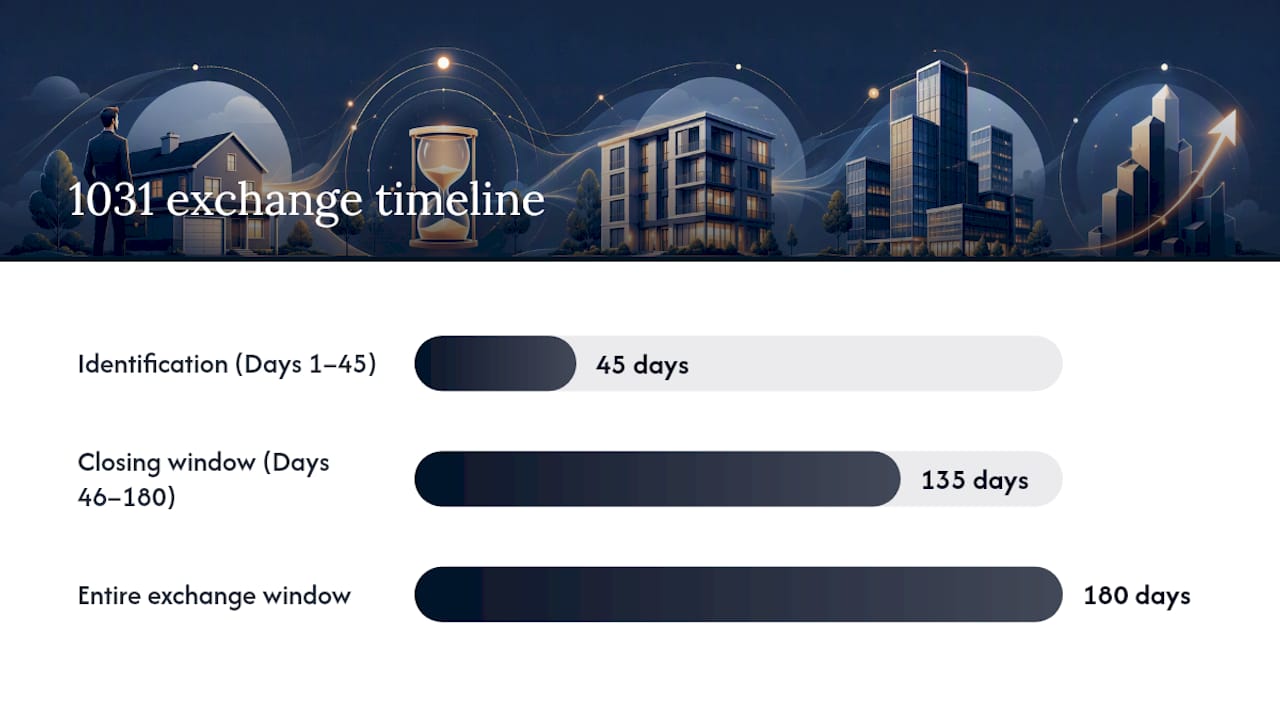
A 1031 exchange gives you two hard, calendar-day deadlines that run simultaneously from the moment you close on your relinquished property: 45 days to identify your replacement property in writing and 180 days to close on it (or by your federal tax return due date including extensions, whichever comes first). Both clocks start on Day 0, the date of the relinquished property transfer. Miss either one and the IRS treats the exchange as failed, making your entire capital gain immediately taxable.
- Day 0: Relinquished property closes. Both clocks start.
- Day 45: Written identification of replacement property must be delivered to your Qualified Intermediary (QI).
- Day 180 (or earlier): Replacement property must close. The outer cap is the earlier of 180 calendar days or your federal tax return due date (with extensions) for the year of sale.
The 45-day identification deadline is the real gatekeeper. You can have 135 days left to close and still lose the exchange entirely if you missed Day 45. Under IRC §1031 and Treas. Reg. §1.1031(k)-1, these rules carry no exceptions for personal hardship, financing delays, or market conditions.
Table of Contents
- How the 1031 exchange timeline works from Day 0 to Day 180
- How the 180-day exchange period and the “earlier-of” rule affect your closing
- What a Qualified Intermediary does and why you cannot be your own
- How other exchange structures change your timeline
- What causes exchanges to fail and what it costs you
- What to do before you close on the relinquished property
- Three date-math examples you can copy for your own exchange
- How to report a 1031 exchange on your tax return
- Tools that help you track deadlines and avoid boot
- Key Takeaways
- The mistake most investors make is treating Day 180 as the only deadline
- Real Estate Investor Toolkit keeps your exchange on schedule
- Authoritative sources to verify these rules
How the 1031 exchange timeline works from Day 0 to Day 180
The entire exchange period is a single 180-day window, not two sequential blocks. The 45-day identification period sits inside the 180-day exchange period. Think of it as one race with two checkpoints.
| Milestone | Calendar Day | What Must Happen |
|---|---|---|
| Day 0 | Closing date | Relinquished property transfers; both clocks start |
| Day 1–44 | Pre-identification window | QI holds proceeds; you research and vet replacement properties |
| Day 45 | Identification deadline | Written ID delivered to QI by midnight |
| Day 46–180 | Closing window | Close on an identified replacement property |
| Day 180 (or earlier) | Exchange deadline | Outer cap; earlier if tax return due date falls before Day 180 |
The “earlier-of” rule matters most for Q4 sellers. If you sell in October, your federal tax return is due April 15 of the following year (roughly 165–170 days away). Without a filing extension, that due date cuts your exchange window short of the full 180 days. Filing Form 4868 (or the entity equivalent) pushes the return due date to October 15, restoring the full 180-day window.
Key calendar mechanics to know:
- Calendar days only — Weekends and federal holidays count toward both deadlines. The IRS confirms there is no business-day rollover. If Day 45 falls on a Sunday, Sunday is your deadline.
The three identification rules
You can identify more than one property, but the IRS limits how many and at what value. Three main rules apply to govern identification, and you must satisfy at least one of these rules.
Pro Tip: Aim to submit your identification notice by Day 30–40, not Day 44. This gives you time to correct errors, confirm delivery with your QI, and add backup properties if a primary deal falls through. You can revoke or amend an identification at any time before midnight on Day 45, but not after.
A sample identification notice should include: the taxpayer’s name and signature, the date, the QI’s name and address, and a clear property description for each identified property. Keep a copy with your QI correspondence file.
How the 180-day exchange period and the “earlier-of” rule affect your closing
The 180-day exchange period is the outer cap, not a guaranteed window. Two rules can shorten it.
Rule 1: The tax return due date. Under IRC §1031, the exchange must be completed by the earlier of 180 days or the due date (including extensions) of your federal income tax return for the year the relinquished property was sold. For most individual investors, that is April 15 without an extension.
| Sale Month | Approx. Days to April 15 | Action Needed |
|---|---|---|
| January | 135 days | File extension immediately to preserve 180 days |
| July | — | April 15 is not a constraint; 180-day cap applies |
| October | ~165 days | File extension to avoid losing ~15 days |
| December | 45 days | File extension immediately; 180 days extend to ~June |
Rule 2: Boot and equity/debt replacement. Even if you close within 180 days, receiving cash or non-like-kind property creates taxable “boot.” To achieve full capital gains tax deferral, you must:
- Replace all equity: the replacement property’s purchase price must equal or exceed the relinquished property’s net sale price.
- Replace all debt: if your relinquished property carried a $400,000 mortgage, the replacement must carry at least $400,000 in debt (or you must contribute equivalent cash).
A simple example: You sell a property for $600,000 with a $200,000 mortgage, netting $400,000 in equity. If you buy a replacement for $550,000 with a $150,000 mortgage, you have replaced only $150,000 of the $200,000 in debt. The $50,000 shortfall is treated as boot and is taxable in the year of the exchange.
Use the Investment Property Financing Calculator to model debt replacement scenarios before you commit to a replacement property.
No routine extensions exist. The IRS grants deadline relief only in the case of federally declared disasters under Rev. Proc. 2018-58. Financing delays, title issues, and personal hardship do not qualify.
What a Qualified Intermediary does and why you cannot be your own
A Qualified Intermediary is not optional. The IRS requires one for any deferred exchange, and the QI’s role is to hold your sale proceeds so you never take constructive receipt of the funds. The moment you touch the money, the exchange fails.
What the QI does:
- Enters into a written exchange agreement with you before the relinquished property closes.
- Receives the sale proceeds directly from the closing.
- Holds funds in a segregated account during the exchange period.
- Transfers funds to the replacement property closing on your instruction.
- Receives and timestamps your identification notice on Day 45.
Who cannot serve as your QI:
- You (the taxpayer).
- Your spouse or certain family members.
- Anyone who has served as your agent within the prior two years: your attorney, CPA, real estate broker, investment banker, or financial advisor. This disqualification applies even if the relationship has since ended.
The IRS fact sheet FS-2008 explicitly prohibits acting as your own facilitator and confirms that the exchanger cannot have actual or constructive receipt of the funds.
QI insolvency risk is real. QIs are not federally regulated or insured. Several high-profile QI failures have left investors with lost exchange funds and failed exchanges. Before you sign with a QI:
- Confirm they carry fidelity bond and errors-and-omissions insurance.
- Verify funds are held in a qualified escrow or trust account, not commingled with the QI’s operating funds.
- Check their membership in the Federation of Exchange Accommodators (FEA).
- Review the exchange agreement for your right to direct funds and for any indemnification provisions.
Pro Tip: Ask your QI for a copy of their fidelity bond certificate and the name of the bank holding your funds. A reputable QI will provide both without hesitation. If they resist, find another QI.
How other exchange structures change your timeline
Not every 1031 exchange follows the standard deferred structure. Three variations carry distinct timeline mechanics.
Simultaneous exchange: The relinquished and replacement properties close on the same day. The timeline is effectively immediate, but you still need a QI to facilitate the transfer. There is no 45-day or 180-day window because both transactions happen at once.
Reverse exchange: You acquire the replacement property before selling the relinquished property. An Exchange Accommodation Titleholder (EAT) takes title to either the replacement or the relinquished property while you complete the sale. The clock starts on the date the EAT acquires the parked property. From that date, you have 45 days to identify the relinquished property (the one you will sell) and 180 days to complete the exchange. Reverse exchanges are more complex and expensive, but they solve the problem of losing a replacement property while waiting to sell.

Construction/improvement exchange: Also called a build-to-suit exchange, this structure allows you to use exchange proceeds to improve a replacement property before taking title. The EAT holds title during construction. The same 180-day window applies from Day 0, and all improvements must be substantially complete and title must transfer to you within that window. Any unspent improvement funds at Day 180 are treated as boot.
Each of these structures requires a QI or EAT from the start. Attempting to set one up after the relinquished property closes is too late.
What causes exchanges to fail and what it costs you
The most common exchange failures are preventable. Here is where investors go wrong and what it costs them.
Frequent causes of failure:
- Missing the Day 45 identification deadline (the single most common fatal error).
- Identifying properties that do not meet the description requirements.
- Taking constructive receipt of proceeds (touching the funds before the exchange closes).
- Using a disqualified person as the QI.
- Failing to close on an identified property within 180 days.
- Identifying only one property and losing that deal after Day 45.
Tax consequences of a failed exchange:
- Full capital gain recognition in the year of sale, taxed at long-term capital gains rates (up to 20% for high-income taxpayers).
- Depreciation recapture at 25% on accumulated depreciation.
- Net Investment Income Tax (NIIT) applies to taxpayers above income thresholds.
- State income tax on the gain varies by state and can be significant in higher-tax states.
The combined federal tax impact from depreciation recapture, capital gains, and NIIT can be substantial for many investors.
Limited relief: Rev. Proc. 2018-58 allows the IRS to postpone 45-day and 180-day deadlines when the President declares a federal disaster. This relief is rare, geographically limited, and not guaranteed. Do not plan around it.
Quick failure checklist: Before Day 45, confirm you have done all of the following:
- [ ] QI engaged and exchange agreement signed before relinquished closing.
- [ ] Proceeds wired directly to QI at closing.
- [ ] Written identification notice prepared, signed, and delivered to QI.
- [ ] Delivery confirmed in writing by QI.
- [ ] At least one backup property identified.
What to do before you close on the relinquished property
The 45-day clock is unforgiving. The investors who navigate it cleanly are the ones who started their preparation weeks before the relinquished property closed.
- Research and inspect replacement candidates. Identify at least two or three serious candidates before Day 0. Use the Real Estate Comps Analyzer to value candidates and confirm they meet the 200% rule if you plan to identify more than three properties.
- File a tax return extension if selling in Q4 — If your relinquished property closes between October and December, file Form 4868 (or the entity equivalent) immediately to push your return due date to October 15 and preserve the full 180-day exchange window.
- Estimate your boot exposure. Use a rehab cost calculator and a debt/equity replacement model to confirm your replacement property purchase price and financing will cover your full equity and debt from the relinquished sale.
Pro Tip: DSTs are particularly useful when a primary replacement deal falls through after Day 45. Because you cannot identify new properties after the deadline, having a DST already on your identification list means you always have a qualifying option available. Many advisors recommend including at least one DST on every identification notice as standard practice.
Three date-math examples you can copy for your own exchange
Example A: Mid-year sale
- Day 180: — November 28 (exchange deadline). Target: close replacement by November 14 (Day 165).
- Tax return impact: — April 15 is well past Day 180, so the tax return due date is not a constraint.
| Milestone | Date | Notes |
|---|---|---|
| Day 0 | June 1 | Relinquished closes |
| Internal ID target | July 6 | Day 35 — submit early |
| Day 45 deadline | July 16 | Absolute cutoff |
| Internal close target | November 14 | Day 165 — buffer before cap |
| Day 180 deadline | November 28 | Outer cap |
Example B: Late-year sale with tax return trap
- Without extension: — Tax return due April 15 = Day 165. Exchange window closes April 15, not Day 180.
Filing the extension is the single action that preserves 15 days of exchange window for a November 1 sale. For a December 1 sale, the extension recovers nearly 75 days.
Example C: Reverse exchange
- Day 180: — August 28. You must close the sale of the relinquished property and complete the exchange by August 28.
In a reverse exchange, the identification obligation flips: you are identifying the property you plan to sell, not the one you plan to buy. The 180-day window is the same, but the direction of the transaction is reversed.
How to report a 1031 exchange on your tax return
Every completed 1031 exchange must be reported to the IRS on Form 8824, filed with your federal income tax return for the year the relinquished property was sold. If your exchange straddles two tax years (relinquished in Year 1, replacement closed in Year 2), you still file Form 8824 with your Year 1 return.
What Form 8824 requires:
- Description of both the relinquished and replacement properties.
- Dates: when the relinquished property was identified for exchange, when it was transferred, and when the replacement was received.
- Fair market values of both properties.
- Gain or loss calculations, including any boot received.
- Related-party disclosures if the exchange involved a related party.
- Adjusted basis of the relinquished property and the calculated basis of the replacement.
The Instructions for Form 8824 walk through each line and explain how to calculate realized gain, recognized gain, and the deferred gain that carries into the replacement property’s basis.
Document checklist for your tax preparer:
- Signed exchange agreement with your QI.
- Closing statements for both the relinquished and replacement properties.
- Copy of the written identification notice with QI delivery confirmation.
- QI account statements showing fund receipt and disbursement.
- Any disaster-relief correspondence if Rev. Proc. 2018-58 relief was claimed.
- Prior depreciation schedules for the relinquished property.
Keep these records for at least three years after the year you eventually sell the replacement property in a taxable transaction, since the deferred gain carries forward.
Tools that help you track deadlines and avoid boot
Managing a 1031 exchange without a tracking system is how investors miss Day 45. The deadlines are mechanical, and a calendar reminder set for the wrong date can cost you the entire deferral.
The tools you need fall into three categories:
- Timeline calculators — that take your Day 0 date and output Day 45, Day 180, and the tax return due date, flagging the controlling deadline automatically.
- Debt and equity replacement calculators that model whether your replacement property purchase price and financing structure will fully defer the gain or trigger boot. A debt-to-equity calculator can help you stress-test different financing scenarios before you commit.
- Deal analyzers — that value replacement properties against your relinquished sale price, confirm you are meeting the 200% rule if applicable, and model cash flow on the replacement.
Real Estate Investor Toolkit’s DealFlow platform lets you manage multiple replacement property candidates in a single pipeline, track key dates, and run financing scenarios side by side. The financing calculator is particularly useful for modeling debt replacement, since the numbers need to be right before you sign a purchase contract, not after.
Practical tip: Export your Day 45 and Day 180 deadlines into your calendar or project-management tool with reminders set 10 days, 5 days, and 48 hours before each deadline. Build your internal target dates (Day 35 for identification, Day 165 for closing) as separate calendar events so you are working toward a buffer, not the IRS hard stop.
Key Takeaways
A successful 1031 exchange depends on meeting two concurrent, calendar-day deadlines: identify in writing by Day 45 and close by Day 180 (or the earlier tax return due date), with no extensions available except for federally declared disasters.
| Point | Details |
|---|---|
| Two concurrent deadlines | Day 45 identification and Day 180 closing both start on the relinquished property closing date. |
| “Earlier-of” rule for Q4 sellers | File Form 4868 to push your return due date and preserve the full 180-day window. |
| Identification must be formal | Written, signed, delivered to QI by midnight Day 45; street address or legal description required. |
| Boot triggers partial tax | Replace all equity and debt from the relinquished sale to achieve full capital gains tax deferral. |
| Real Estate Investor Toolkit | Use the DealFlow platform and financing calculator to track deadlines and model debt replacement before signing a purchase contract. |
The mistake most investors make is treating Day 180 as the only deadline
The conventional framing of a 1031 exchange puts the 180-day window front and center. That framing is dangerous. In practice, Day 45 is the deadline that kills exchanges, not Day 180.
Here is why: by Day 180, you have had months to line up financing, negotiate a purchase contract, and coordinate closing. The process is slow and visible. Day 45 arrives fast, and the identification rules are technical enough that a well-intentioned investor can submit a notice that fails on a technicality: a vague property description, delivery to the wrong party, or a timestamp that missed midnight by an hour.
The investors who consistently complete exchanges without drama are the ones who treat Day 45 as if it were Day 30. They submit identification notices early, confirm delivery in writing, and always include a DST as a backup on the list. They also build their internal deadlines around a 48-to-72-hour buffer before the IRS hard stops, which means administrative errors get caught before they become fatal.
The other underappreciated risk is the Q4 sale trap. Selling in October, November, or December without immediately filing a tax return extension is one of the most avoidable ways to lose exchange days. The extension costs nothing and takes minutes to file. Skipping it and losing 15 to 75 days of exchange window is a mistake that shows up in the data every year.
For deeper process templates and deal-analysis frameworks, the Real Estate Investor Toolkit learning hub has guides built specifically for investors managing time-sensitive transactions.
Real Estate Investor Toolkit keeps your exchange on schedule
Tracking two concurrent IRS deadlines while evaluating replacement properties, coordinating financing, and managing a QI relationship is a lot to hold in your head. Real Estate Investor Toolkit gives you the calculators and deal-management tools to keep every number and every date in one place.
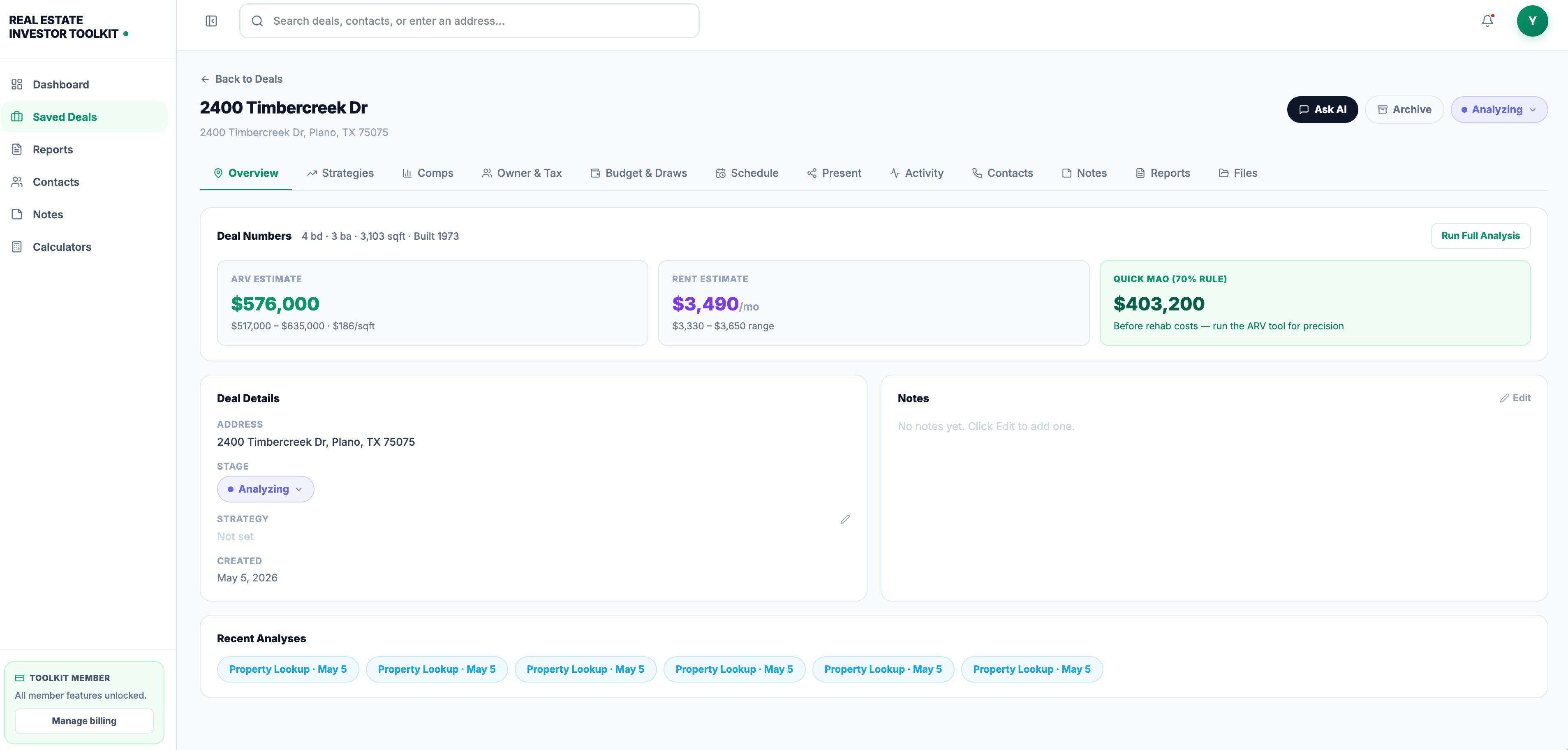
The DealFlow platform lets you build a pipeline of replacement property candidates, track Day 45 and Day 180 milestones, and run side-by-side financing comparisons so you know before you identify whether a property will trigger boot. The financing calculator models debt replacement scenarios in minutes, and the comps analyzer helps you value replacement candidates against your relinquished sale price. Free calculators are available with no sign-up required. Start with the investment guides and frameworks to build your pre-sale checklist, then use the tools to run the numbers before your relinquished property closes.
Authoritative sources to verify these rules
These are the primary legal and regulatory sources that govern 1031 exchange timing. Consult them directly or share them with your tax advisor.
- irs.gov
- Rev. Proc. 2018-58
- Form 8824 (PDF)
- IRS FS-2008 fact sheet
- Instructions for Form 8824
- Like-Kind Exchanges — Real Estate tax tips
- 26 USC 1031
This article provides general information about 1031 exchange rules and is not tax or legal advice. Confirm current rules and your specific situation with a qualified tax professional or attorney before proceeding with an exchange.
Recommended
- Blog | Real Estate Investor Toolkit | Real Estate Investor Toolkit
- How to Estimate Holding Costs Before They Kill the Flip Spread — Real Estate Investing Guide | Real Estate Investor Toolkit
- When the 70% Rule Works, When It Breaks, and What to Use Instead — Real Estate Investing Guide | Real Estate Investor Toolkit
- How to Pull Comps in Non-Disclosure States Without Fooling Yourself — Real Estate Investing Guide | Real Estate Investor Toolkit